Building a Company of Agents

Co-Founder & CEO of CLRT
Picture a company with one person at the top and, beneath them, not staff but agents: narrow workers each doing one job well, coordinated by orchestrators, the whole thing running while the founder sleeps. It is a striking image, and the striking part is not the technology. Strip a company down to agents and you discover what the founder's job always was underneath the busywork: decide what, and verify that what got done is what you meant. Everything in between was never the value. It was the cost of not having a system.
This is why managing a company of agents is a fundamentally different act from managing a company of people, and why the people who will be best at it are not necessarily the best people-managers. An agent does not need motivation, morale, or a career path. It needs a precise specification and an independent check. So you do not manage it, you specify it and you verify it. The skill of running a company of agents is closer to engineering intent than to leading a team, and that changes who is good at it.
It also breaks a law that has governed every company in history. Output always required people, and people always required coordination, and past a certain size the coordination cost, the meetings, the handoffs, the management of management, grew faster than the capacity it bought, which is why big companies slow down. A company of agents does not hit that wall in the same way, because the coordination is code, not meetings. The ceiling moves, and the thing that was always the real constraint, the founder's capacity to set direction and verify outcomes, becomes the only constraint that is left.
That last point is the honest one. This is a direction, not a finished destination, and the binding constraint is verification. You can only delegate as much as you can check, so your ability to verify is the true ceiling on how large a company of agents you can run.
The doing was never the job. The managing of doing was never the job. Set the intent, verify the outcome. A company of agents simply removes everything that was hiding that.
A deeper dive
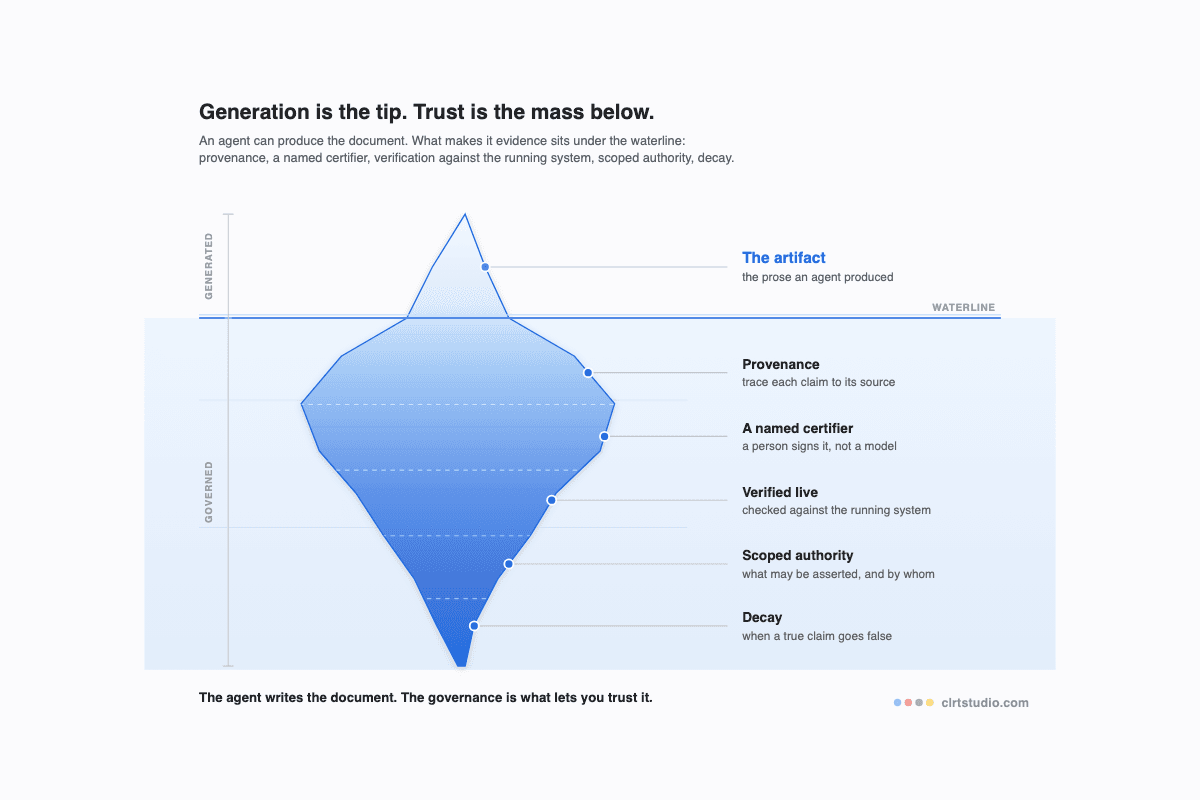
The architecture that works is narrow-and-many, not one-agent-that-does-everything. Each agent handles a single job-shape well (the patterns in The Ten Jobs an AI Agent Is Actually Good At), because narrow agents are more reliable and, crucially, more verifiable than a sprawling generalist whose output you cannot check. Orchestrators sequence them, passing work between steps, and underneath everything sits durable memory and state, because an agent forgets between runs and only an external record lets the company persist what it knows (the argument in Why Your AI Forgets). Verification is wired in at every level, a checker the maker does not control, so "done" means something. The founder sits on top of the loop, not inside every step, which is the move from prompting every task to designing the system that runs (the discipline in Loop Engineering), and the human-touch rate is driven down to genuine exceptions. The whole structure is the organisational mirror of an individual distilling toward their own highest-value work, just scaled to a company. And it returns you to the same constraint every time: it works only as far as you can verify it, so investing in how you check is investing in how large you can grow.
Work with CLRT
A company of agents is not science fiction, it is an architecture, and the founder's job inside it is intent and verification. Designing that architecture for a real business is what CLRT does. Let us map what your company looks like once the doing is handled.

Vishal Sachar is the Co-Founder and CEO of CLRT, where he helps UAE businesses make sense of applied agentic AI and put it to work. He writes on agentic systems, AI governance, and the economics of automation. Reach him at vishal@clrtstudio.com or on LinkedIn.