The Token Bill Is a Judgment Bill

Co-Founder & CEO of CLRT
In May, Forbes reported that Uber had burned through its entire 2026 AI budget in four months, not on a moonshot but on coding agents. Roughly 5,000 engineers had access to Claude Code, adoption climbed from 32 per cent of engineers in February to 84 per cent by March, and while the average monthly cost per engineer ran between $150 and $250, power users were burning $500 to $2,000. By early June, Bloomberg reported, the company was capping usage of the tools to cut costs. Read quickly, this is a story about an expensive tool. Read properly, it is the first public autopsy of a budgeting model most organisations are still using, and the striking thing is how little of it is about price.
Start with what the bill actually bought, because the spend was not waste in any simple sense. Roughly 70 per cent of Uber's committed code now originated from AI, and about 11 per cent of live backend updates were written by agents with no human in the loop. Engineers were not misusing anything. They used the product exactly as designed, running agents in parallel and pointing them at large refactoring jobs; the chief technology officer personally spent $1,200 in a single two-hour session. And yet Uber's own chief operating officer, asked by Fortune whether the spend was showing up where it matters, conceded that the link from all of this to consumer-facing innovation is 'not there yet'. Hold those two facts together. The tool worked. The organisation still could not say what the money was for.
Now add the detail that should unsettle every finance director reading the coverage: all of this happened while the unit price of intelligence was collapsing. On 30 June, Anthropic launched Claude Sonnet 5 at an introductory $2 per million input tokens and $10 per million output, positioned, in TechCrunch's framing, as a cheaper way to run agents, with near-flagship agentic capability at a mid-tier price. Tokens have never been cheaper, and the bills have never been higher. That is not a contradiction; it is the oldest pattern in resource economics. When efficiency lowers the unit cost of a thing, consumption of it expands to swallow the saving, and agentic workloads are consumption machines: an agent plans, acts, checks its work, fails, retries, and spawns sub-agents, and every turn of that loop is tokens. A chat session was bounded by a human's patience. A loop is bounded by nothing except the task you gave it and the budget you forgot to set.
This is why per-seat budgeting is dead, and it is worth being precise about the cause of death. A seat price worked because the seat contained a human, and the human was the rate limiter: one screen, one train of thought, so many working hours in a month. Budgeting per person was really budgeting per unit of human attention, and it survived every previous wave of software because consumption stayed chained to attention. Agents cut that chain. The correct way to read a token bill now is not as a technology cost at all. It is a judgment bill: an itemised record of every task somebody decided, or failed to decide, an agent should attempt. Uber's bill was not too high in any meaningful sense. It was unread. Nobody could look down the lines and say which of them bought something worth more than it cost, because the workloads were never priced against anything.
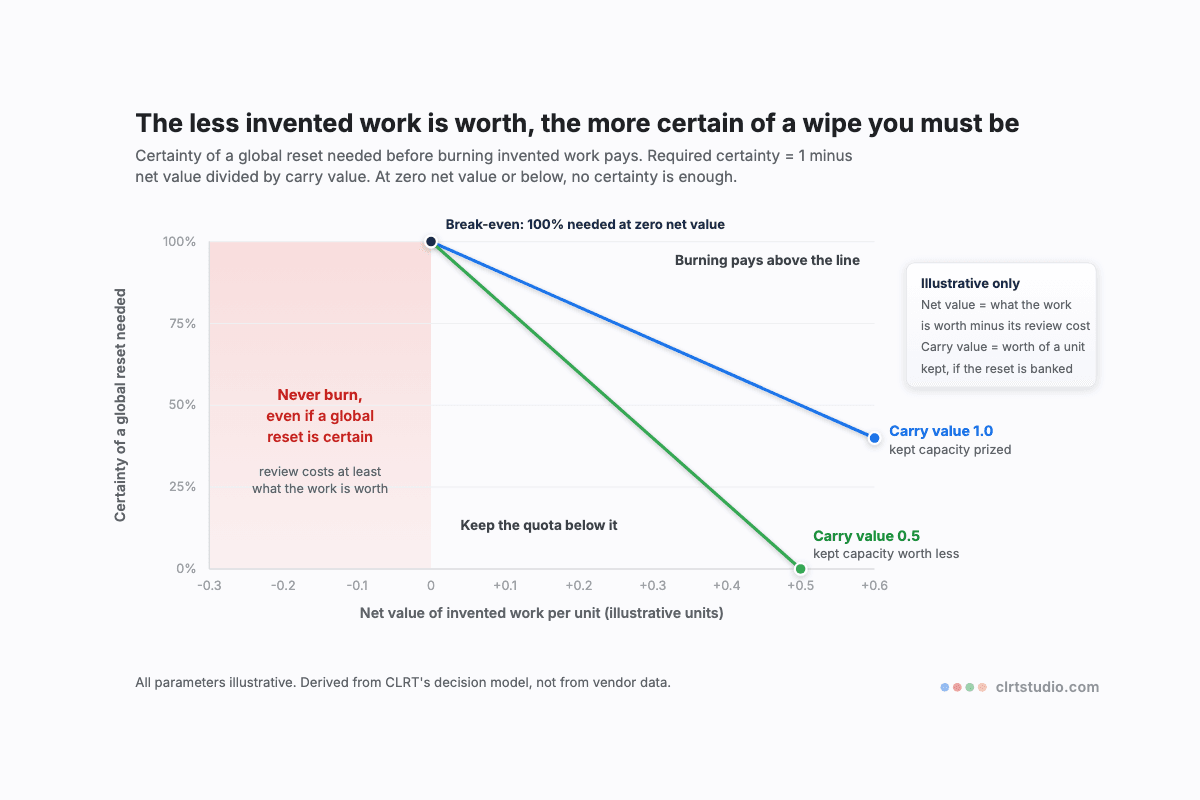
Caps are the instinctive response, and they are the wrong instrument, because a cap is a confession that you cannot tell your good spend from your bad spend. Rationing by volume punishes precisely the engineers the tool was bought for: the power users running large parallel refactors are either your best return on the entire programme or your purest waste, and a cap cannot distinguish the two, so it throttles both. That $1,200 two-hour session might have been the cheapest engineering Uber bought all quarter, or an expensive way to fill an afternoon. The bill cannot tell you, and neither can a finance team reading it afterwards. Only a decision made before the run can: what drain is this agent removing, and what is that drain worth.
There is a discipline that makes the whole problem disappear, and it is a pricing discipline, not a procurement one. Price the agent against the value of the drain it removes. Take the workflow, put a monthly figure on what it costs the business in expensive human attention, and only then decide what an agent is allowed to spend attacking it, holding the run cost to a disciplined fraction of the value it frees. Do that, and the bill cannot outrun the benefit by construction: spend can only grow where value has already been established to justify it, and a workflow whose drain nobody can price is a workflow no agent should be burning tokens on. It is the difference between an AI budget and an AI portfolio, and it is the principle we built into Ascent from the first line.
A token bill is an itemised record of every task somebody decided, or failed to decide, an agent should attempt.
A deeper dive
The deeper point is about which unit of account survives the agentic era, and the answer is the workflow, not the seat and not the token. Per-seat licensing was never a natural law; it was an artefact of software whose consumption was bounded by human attention, and it is telling that the moment that bound broke, at one of the most operationally sophisticated companies in the world, the budgeting failed within a single quarter. The workflow is the unit that carries all three numbers a decision needs: the value of the drain it removes, priced in money per month; the run cost the agent incurs attacking it; and the ratio between them, which is the only figure that tells you whether any given line on the bill is egregious or a bargain. Without the first number, the second is unreadable. A $2,000 monthly bill for one engineer is an outrage if it is automating a chore worth $300, and the cheapest labour the company has ever purchased if it is removing a drain worth $30,000; both verdicts attach to the same line item, and nothing on the invoice distinguishes them. This is also why the problem is about to become general rather than remaining a story about one company. BCG's AI Radar found chief executives committing more than 30 per cent of their 2026 AI budgets to agentic AI, which means thousands of organisations are now scheduled to discover, on their own bills, that they bought consumption without pricing workloads.
It is also worth naming the vendor-side dynamic plainly, because it will not be named for you. A model priced at $2 per million input tokens and marketed as a cheaper way to run agents is not designed to shrink your bill; it is designed to make previously marginal workloads economical, which grows total consumption. That is not sinister, it is simply the vendor's side of the trade, and it means falling unit prices should be read as an invitation to expand usage, never as relief on the invoice. The counterparty discipline has to live on your side, and caps are not it. A cap rations volume when the problem is unpriced value, and it decays badly: teams learn to hoard quota, the highest-leverage work is the first to hit the ceiling, and the organisation quietly reverts to humans doing drain work an agent should own, which is the most expensive outcome of all because it is invisible. The instrument that actually works is a run budget set per workflow, derived from the value that workflow frees, with stop conditions so a loop cannot spend past its justification, and attribution so every line of the bill traces to a named decision and a named return. That turns the token bill into something a leadership team can read the way it reads a P&L. Building that layer is unglamorous systems work, which is exactly why it is skipped, and why the gap between organisations that have it and organisations that cap is about to compound.
Key terms
- Jevons paradox
- The nineteenth century observation that when efficiency lowers the unit cost of a resource, total consumption of it tends to rise rather than fall. Cheaper tokens grow the bill wherever workloads are free to expand.
- Run cost
- The tokens an agent consumes executing a workflow: planning, acting, checking, retrying. It accrues per task attempted, not per person seated, which is why seat budgets cannot contain it.
Work with CLRT
This arithmetic is the spine of CLRT Ascent. The diagnostic prices the drain in a workflow first, in dirhams, and only then sizes what an agent is worth against it, so that run cost stays a disciplined fraction of the value it frees and the bill cannot outrun the benefit by construction. If your token spend is growing and nobody in the building can say which lines pay for themselves, do not reach for a cap. Take the diagnostic, and price the work before you price the tokens.

Vishal Sachar is the Co-Founder and CEO of CLRT, where he helps UAE businesses make sense of applied agentic AI and put it to work. He writes on agentic systems, AI governance, and the economics of automation. Reach him at vishal@clrtstudio.com or on LinkedIn.