Good, Not Leverage

Co-Founder & CEO of CLRT
There is a three word sentence buried in the design of CLRT Ascent that took more argument than anything else in the product: good, not leverage. Ascent finds your Zone of Genius, the narrow band of work you are both genuinely good at and energised by, and then does the thing no readiness tool on the market is built to do. It weighs that work against the goal you actually stated, and when a task you love does not move that goal, it says so, in those words. This piece is about why that sentence is the hardest output a diagnostic can produce, and why it is worth more than everything else the report returns.
Start with the market this sentence has to survive in. Expectation around agents has never been higher: BCG's AI Radar, published in January, found that roughly 90 percent of CEOs expect AI agents to deliver measurable returns this year, and boards are moving budget accordingly. Into that demand the market supplies an endless shelf of readiness scans, maturity quizzes, and opportunity calculators, and almost all of them share one design decision: they exist to open a sales conversation, so they are engineered to leave you feeling capable and nearly ready. Flattery converts. A tool that tells a founder their favourite work is exactly where they should double down gets shared, quoted, and followed by a call booking. A tool that disagrees gets closed. Every incentive in the category points one way, which is why the category almost never produces an unwelcome answer.
Ascent's answer to this is structural, not tonal. The first thing the diagnostic captures is the goal you are actually pursuing, in your own words, and from that point on the goal is the arbiter. Everything that follows is evidence to be weighed against it. Your Zone of Genius, as I argued when I first wrote about it, is a conclusion the evidence either supports or refuses, never a label you claim. But the deeper move comes after the zone is found, because skill and energy are facts about you, and leverage is a fact about the goal. Work can be genuinely excellent, genuinely energising, and still leave the stated goal exactly where it was. When the evidence says that, Ascent says it too: this work is good, not leverage. No score inflation softens it, and no lens reframes it, because a diagnostic that cannot render that verdict cannot render any verdict worth paying attention to.
Producing that sentence without losing the respondent is a design problem, and we treated it as one. The diagnostic opens by seeing you accurately: it names what you are good at and what feeds you, and it earns trust precisely because the recognition is real rather than generic praise. Then the evidence starts pushing back, and the experience deliberately dips. The trough is the moment the verdict lands, the task you would have named as your strength revealed as work the goal does not need from you. The reason the trough is survivable is what sits on the other side of it: the diagnostic names where your leverage actually lives and prices the drain in dirhams, so the unwelcome sentence is immediately followed by the valuable one. Flattery skips the trough, and it skips the payoff with it. The arc is the argument: you cannot be shown where your leverage is without first being shown where it is not.
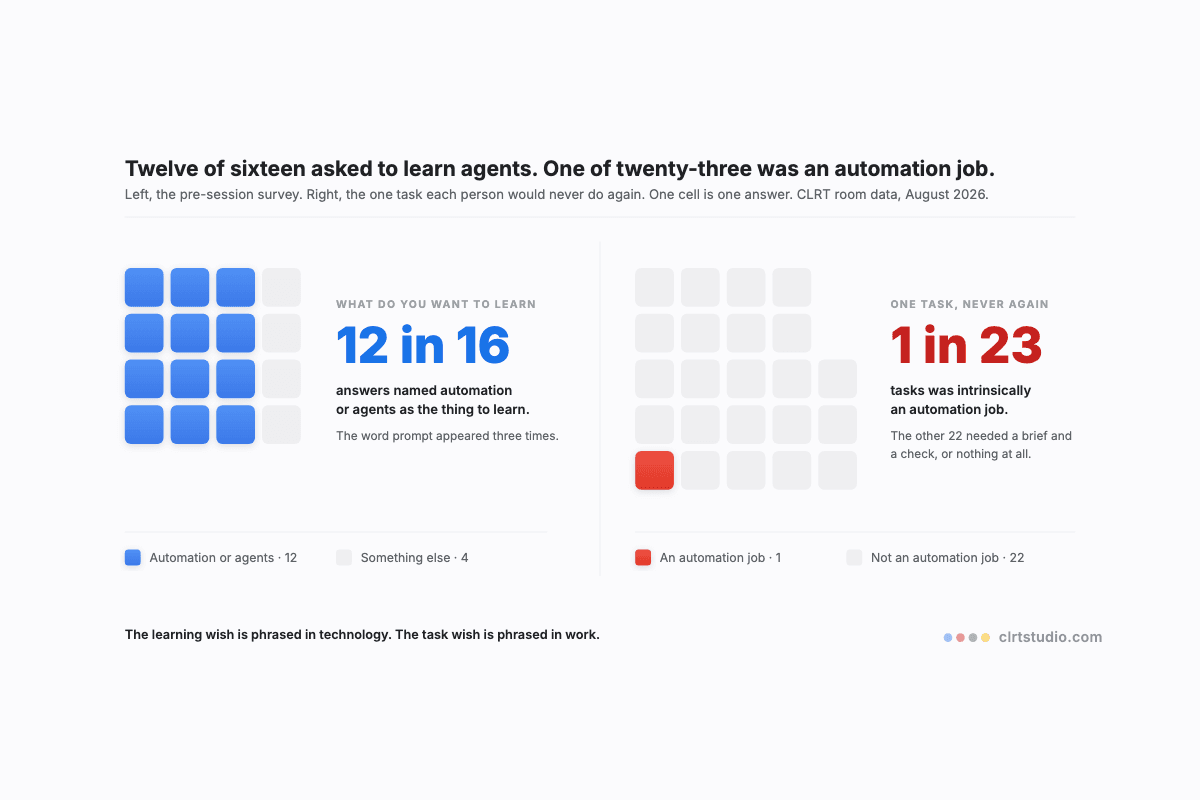
The discipline generalises far beyond one product. Every founder I have sat with has a favourite task that feels like the business but does not move it: the proposal they still write personally, the report they still assemble, the channel they still run because they were the first to run it. The task survives every reprioritisation, not because it was tested against the goal but because it never was. And nobody in the founder's orbit will test it. Employees carry career risk, advisers carry relationship risk, and the founder carries the heaviest bias of all, because the task is usually who they were when the company started. Naming it takes an outside instrument with no stake in being liked, whose only loyalty is to the goal as stated. That freedom to be unwelcome is not a feature of such an instrument. It is the entire reason to use one.
Good, not leverage is the sentence a mirror cannot say.
A deeper dive
It is worth being precise about why the configurators Ascent gets compared to cannot produce this sentence, because the failure is structural, not a matter of nerve. A typical readiness scan takes self-report in and hands self-report back: it asks how you rate your own data, your own processes, your own appetite, then multiplies those ratings into a score, which means it can only ever return your opinion of yourself wearing the costume of analysis. It has no arbiter, because it never captured a goal to weigh anything against, and it has no freedom, because its economics depend on the respondent finishing the experience warm. Ascent inverts all three decisions. The goal is captured first and held fixed, so every subsequent piece of evidence has something to answer to. The interrogation is of evidence rather than self-assessment, which is what makes an unwelcome conclusion reachable at all. And the willingness to return that conclusion is protected on purpose, accepted as a cost in short-term conversion and treated as the source of long-term trust, because the flattered respondent churns the moment reality disagrees with their report, while the respondent who was told the truth comes back with the next workflow. The scoring methodology and the calibration behind the verdict stay proprietary, as I noted when introducing Ascent, and that is deliberate. What matters to a reader is the principle: a verdict is only as valuable as the instrument's freedom to reach the version of it you did not want.
The deeper reason the favourite task goes unexamined is that it hides inside true statements. The founder who still writes every proposal is genuinely the best writer of proposals in the building. The work is genuinely good, clients genuinely praise it, and it genuinely contributed once, usually in the era when proposals were the constraint on the business. All of that can be true while the goal has moved on to a constraint the founder's hours never touch, which is why self-audit fails here: every fact the founder checks comes back reassuring, because they are checking the quality of the work rather than its relationship to the goal. The tell is time. Ask when the stated goal last moved because of the task, not whether the task went well, and the reassuring facts go quiet. This is the same discipline that runs through everything we build at CLRT: an agent pointed at a chore saves an hour, an agent pointed at the constraint moves the unit economics, and the judgment about which is which is worth more than the automation itself. The favourite task is simply the hardest case of that judgment, because the person who must accept the answer is the person the answer is about, and that is precisely the case where an instrument earns its keep.
Key terms
- Zone of Genius
- The narrow band of work a person is both genuinely good at and energised by. In Ascent it is a conclusion the evidence supports or refuses, not a label the respondent claims.
- Good, not leverage
- Ascent's verdict on work that is genuinely skilled and energising but does not move the goal the respondent stated. The task is worth keeping only if the goal changes.
Work with CLRT
Ascent exists to be that instrument. It takes one person and one workflow, holds the goal you state as the arbiter, and returns an Agentic Growth Score and a brief that prices your real drain in dirhams, including, when the evidence says so, the sentence you were hoping not to hear. Take the diagnostic, and bring it the task you would defend hardest. That is the one it is built for.

Vishal Sachar is the Co-Founder and CEO of CLRT, where he helps UAE businesses make sense of applied agentic AI and put it to work. He writes on agentic systems, AI governance, and the economics of automation. Reach him at vishal@clrtstudio.com or on LinkedIn.