The Unallocated Hour

Co-Founder & CEO of CLRT
In March 2026 the most carefully instrumented study of AI and work anywhere reached its revised form. Anders Humlum and Emilie Vestergaard matched roughly 25,000 Danish workers to the state's administrative records, which means they did not have to ask anyone what happened to earnings and hours. They could read it. The finding is a paradox stated plainly: the time savings from AI chatbots are real and widely reported, yet the effect on earnings and hours is a precise null, with confidence intervals ruling out anything larger than 2% two years after ChatGPT launched. Most commentary read that as proof the technology is overhyped. I read it as evidence of something more uncomfortable. The hour is genuinely coming back. It is then disappearing, and nobody is watching where it goes.
It is worth pausing on why this study outweighs the survey headlines it contradicts. Almost everything written about AI productivity rests on self-report, people telling researchers they feel faster. Register data removes the feeling: earnings, hours and job moves come straight from administrative records, worker by worker, across the eleven occupations most exposed to chatbots. The savings themselves are unspectacular but solid. Adopters in the Danish sample report saving about 3% of their work hours, consistent with Bick, Blandin and Deming's representative US surveys, which put the economy-wide figure at roughly 1.4% of all work hours. And yet even the heaviest users, the people saving more than an hour every day, show no detectable movement in what they earn or the hours they record. The tool works. The economics do not move. Something between the saving and the balance sheet is absorbing the hour.
The paper contains the number that explains it. Asked what they do with the time chatbots save them, 85% of users say they reallocate it to other tasks in the same job. Only 8% report that AI has given them entirely new work, a figure that roughly doubles, to about 18%, where employers actively push adoption. Read those shares together and the null result stops being mysterious. The freed hour is not banked, priced or redeployed. It dissolves back into the job it came from, spread thinly across the same tasks, the same inbox, the same meetings. Even in best-practice workplaces, where 19% of workers save more than an hour a day, earnings and hours stay flat. Nobody decided where the hour should go, so it went where hours go when nobody decides.
There is a second leak, and it sits upstream of the allocation problem. In January 2026 Workday published research conducted with Hanover Research across 3,200 employees at firms above $100 million in revenue. It is vendor-commissioned work and should be read as such, though the finding runs against the vendor's interest: 85% of employees report saving between one and seven hours a week with AI, and nearly 40% of that reported saving burns off in correcting, rewriting and verifying the output. Only 14% consistently see a clear, positive net outcome, and 77% of daily users review AI output as carefully as human work or more carefully. None of this is an argument against the tools. Verification is simply the cost of using a probabilistic instrument on work that matters. The problem is that almost nobody nets that cost out of the business case, so the hour that survives is smaller than the hour on the slide, and the allocation decision never happens anyway.
So here is the reframe I would put in front of any leadership team. The freed hour is now the most valuable unallocated asset in your company. Every other asset of comparable value has an owner, a budget line and an approval path. This one has none. It is being spent, invisibly and continuously, by whoever happens to be holding it, on whatever work happens to be in front of them, and the Danish evidence says that in 85 cases out of 100 the default wins. The difference between the firms that will eventually show AI in their operating results and the firms producing these null effects is not model choice, spend or adoption rate. Adoption is nearly solved. The difference is whether someone with authority decided, at the level of a specific person and a specific workflow, where the recovered hours go. That is not a tooling question. It is a judgment question, and it is going unanswered in almost every organisation using AI today.
The freed hour is the most valuable unallocated asset in the company, and it is being spent by default.
A deeper dive
The methodological detail worth internalising is why this particular null is so hard to argue with. Humlum and Vestergaard run difference-in-differences designs at both the worker and the workplace level, with confidence intervals tight enough to rule out effects larger than 2%. The obvious objections are all tested. Perhaps the effects concentrate in super users: workers using chatbots daily, or saving more than an hour a day, show no differential earnings change. Perhaps employers have to lead: workplaces that combine encouraged use, enterprise chatbots and training reach 93% adoption and 28% daily use, and the nulls hold there too. What the paper does find moving is the composition of work itself, new tasks in content generation, AI oversight and AI integration. That is the signature of a technology being absorbed by reorganisation rather than converted into margin. The savings are also lumpy in a way the averages hide. Economy-wide, generative AI currently saves on the order of 1% of work hours, which sounds dismissible until you notice that in well-run workplaces one worker in five is recovering more than an hour a day. An asset that is thin on average and thick in specific seats cannot be captured with a company-wide policy. It can only be captured seat by seat, which is exactly why almost nobody captures it.
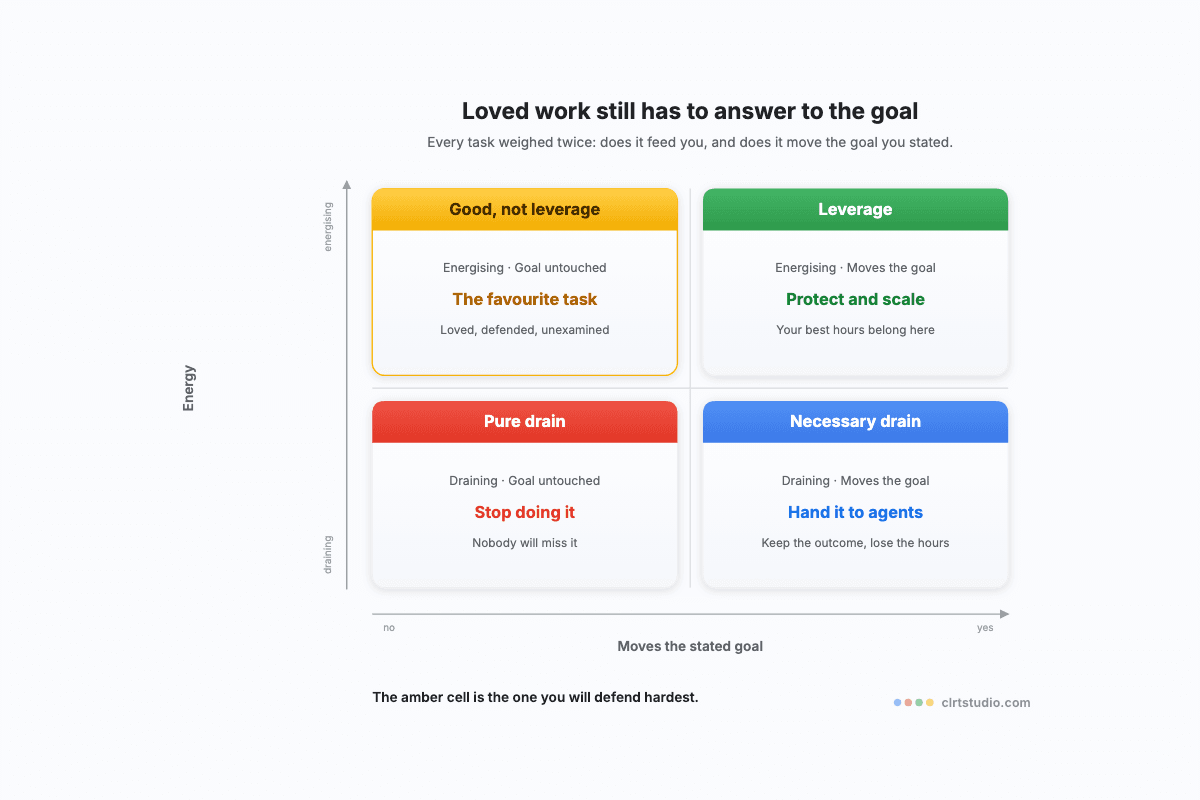
Deciding well is harder than it sounds, which is why the default keeps winning. The first step is subtraction: net the verification cost out of the headline saving, and accept that the netting differs by workflow, because an hour saved drafting a contract that must then be checked line by line is not an hour, while an hour saved summarising internal notes mostly is. The second step is pricing: the surviving time is worth the loaded cost of the specific person recovering it, which means an hour in one seat can be worth twenty times an hour in another. The third step is the actual decision, and there are only three honest options. Let the person go deeper on the same work, which is the default and usually the lowest-yield choice. Absorb more volume of the same work, which is a real but bounded gain. Or move the person up the value chain toward the work only they can do, which is where the compounding lives and which requires a leader to redesign the role. None of these steps can be read off a dashboard, because the inputs are a specific person's week, a specific workflow's verification burden and a specific business's economics. That is why we built Ascent to operate at exactly that resolution: one person, one workflow, the saving netted of checking cost and expressed in dirhams, so the allocation stops being a feeling and becomes a decision someone can own.
Key terms
- Register data
- Administrative records held by the state, covering earnings, hours and employment, that let researchers measure outcomes directly instead of relying on what workers report or remember.
- Precise null
- A result that is not merely statistically insignificant but tightly bounded near zero, so that meaningful effects can be ruled out rather than simply going undetected.
Work with CLRT
This is the question CLRT Ascent was built to answer. It takes one person and one workflow, interrogates where the time actually goes, nets the verification cost out of the saving, and returns a dirham figure for what the recovered hours are worth and where they should be pointed next. The diagnostic is deliberately uncomfortable: it will tell you the freed hour is being spent on work that never deserved it. If your teams are visibly faster and your results are visibly unchanged, do not buy more tooling. Take the diagnostic, and make the allocation of the hour a decision with an owner.

Vishal Sachar is the Co-Founder and CEO of CLRT, where he helps UAE businesses make sense of applied agentic AI and put it to work. He writes on agentic systems, AI governance, and the economics of automation. Reach him at vishal@clrtstudio.com or on LinkedIn.