Return on Energy

Co-Founder & CEO of CLRT
Businesses measure return on capital and return on investment obsessively. Founders should track something earlier and far more predictive: return on energy. ROE is the yield you earn on the one input you can never raise more of. You can always raise more money. You cannot raise more energy.
Consider the inputs a founder actually has. Capital can be raised. Time can be bought, in the form of other people. Energy, the finite drive and attention of the founder, has no external supply. There is no round you can close to top it up. And a founder running on depleted energy makes worse decisions regardless of how much capital sits in the account, which is why energy, not money, is the true binding constraint on most early companies.
Return on energy is the value created per unit of that energy spent. It runs high when the founder's energy flows into their Zone of Genius, the narrow band of work they are both genuinely good at and energised by, and low when it leaks into work that drains without compounding. Its great virtue as a metric is that it moves first. It predicts burnout and stagnation before the financial statements show either, which means a company can look healthy on paper while its single most important person is being quietly spent on the wrong things.
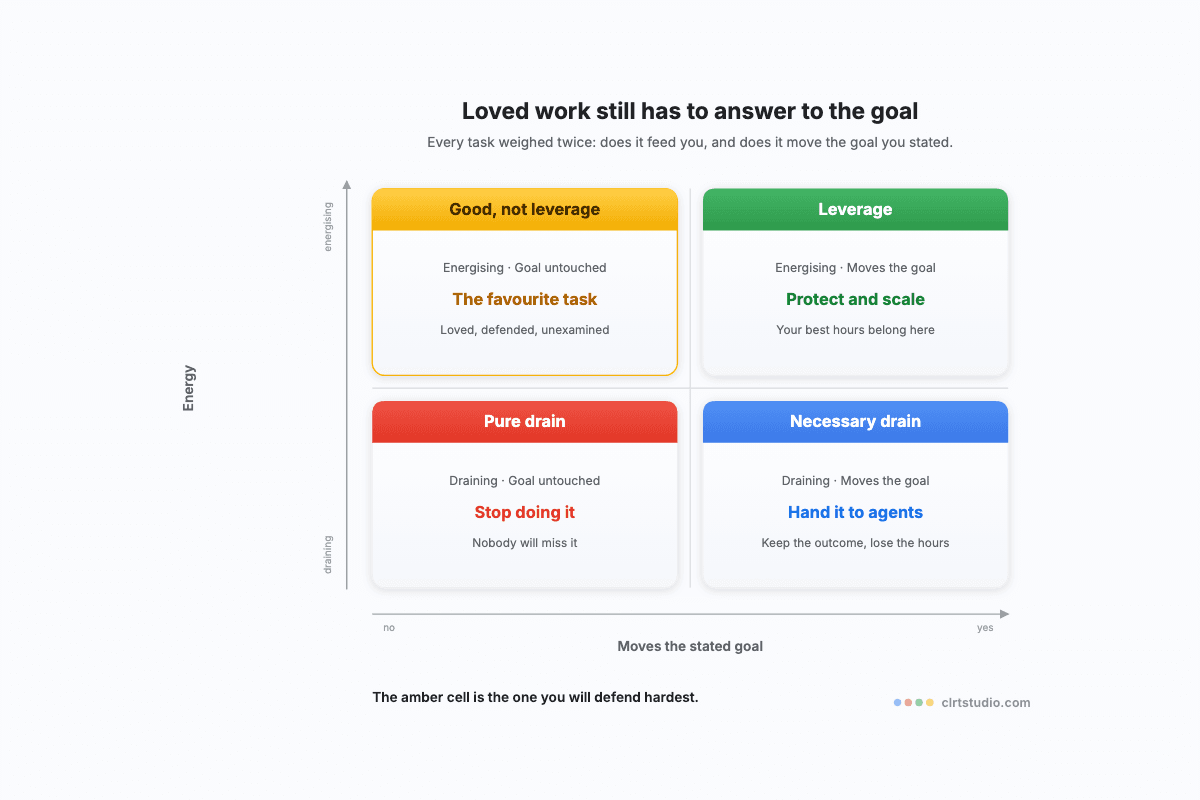
Raising ROE is not about working harder, which only burns the scarce input faster. It is about pointing the same energy at higher-leverage work and routing everything else to people and to agents.
You can raise more money. You cannot raise more energy. Spend it where it returns the most.
A deeper dive
The reason energy rather than time is the right denominator is that the two are not interchangeable. Two hours spent on work you are great at and energised by can produce more than ten hours of draining competence, so measuring output per hour flatters the wrong work and hides the real cost of the tasks you are skilled at but quietly drained by. ROE reframes delegation from a cost-saving exercise into a yield-protection one: every drain you remove from the founder raises the return on the energy that remains, which is the personal-scale version of redeployment, freeing a person's best capacity by routing their draining work elsewhere rather than cutting the person. And there is a structural reason it matters beyond the founder's wellbeing. The decisions that only the founder can make are the ones that bend the company's trajectory, so the founder's return on energy effectively sets the ceiling on how fast the whole business can compound. Protecting it is not self-indulgence. It is capital allocation applied to the scarcest asset in the company.
Work with CLRT
Raising a founder's return on energy is mostly a question of what to route away from them, and to what. CLRT designs the agent layer that carries the drain. Start with a conversation about where your energy is leaking.

Vishal Sachar is the Co-Founder and CEO of CLRT, where he helps UAE businesses make sense of applied agentic AI and put it to work. He writes on agentic systems, AI governance, and the economics of automation. Reach him at vishal@clrtstudio.com or on LinkedIn.