The Fiftieth Approval

Co-Founder & CEO of CLRT
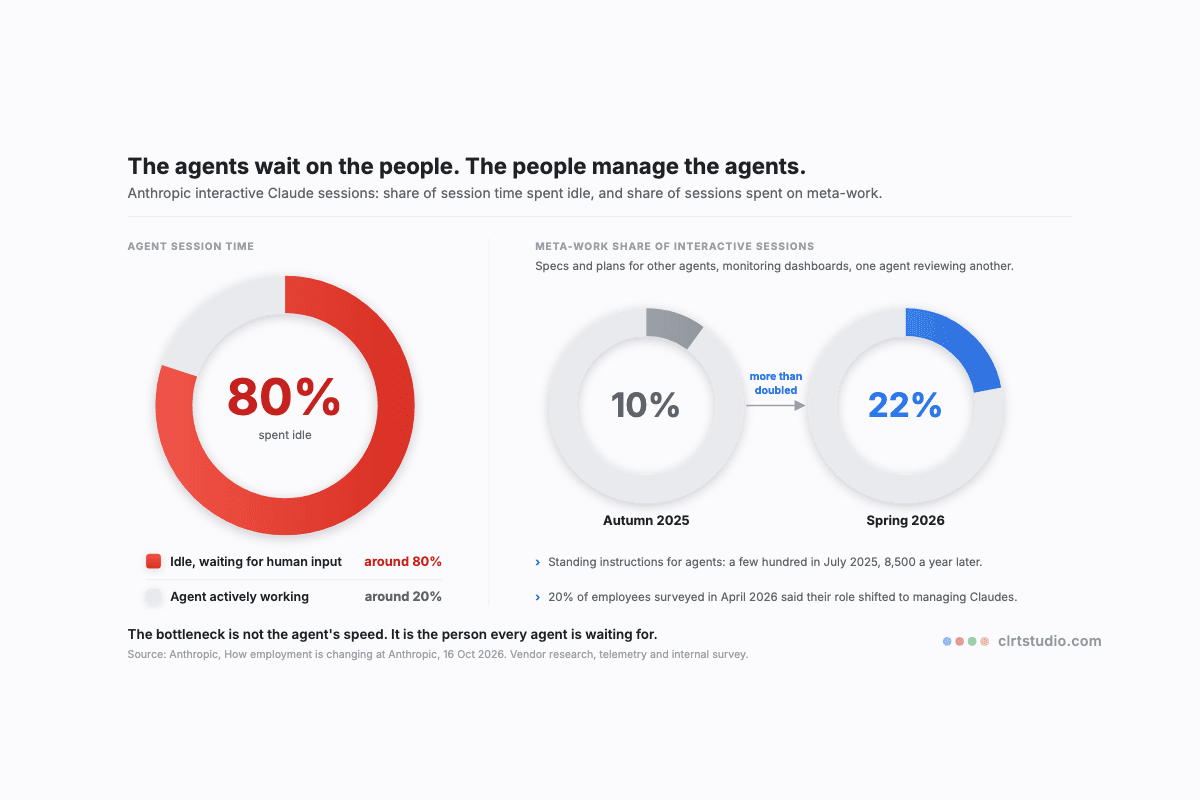
Most agent governance policies I read contain the same reassuring sentence: a person approves every action the agent takes. It sounds like oversight, and it satisfies an auditor. What almost no organisation has done is count the approvals. Anthropic, which builds one of the most widely used coding agents, did count. Its own product data is vendor research and should be read that way, but it is blunt: users approve 97% of the permission prompts the agent raises. The company describes those prompts as asking people to make dozens or hundreds of important security decisions every day, in the middle of other work. At that volume an approval stops being a judgment and becomes a reflex. The question worth asking is not whether a human is present. It is whether the human has any attention left when it matters.
The clearest evidence comes from a controlled study Anthropic published in August. It hired 1,053 paid professional testers for a coding task in a purpose-built test environment and, partway through each session, swapped a single permission prompt for a clearly dangerous command. Approving it ran nothing; the point was to see who would stop. Across the study, testers caught the dangerous command 13.6% of the time. The more telling result sits inside that average. Early in a session, testers blocked about 17% of the dangerous commands. After 50 or more prior prompts, they blocked about 5%. The testers came from the same pool and faced the same danger. What differed was how many approvals each had already given when the dangerous command arrived. Per-action approval is not a control with a fixed strength. It is an attention budget, and the study shows it running down as a session lengthens.
It would be easy to read that as proof that people are poor reviewers. The same dataset says otherwise. When the agent presents a plan for approval, users reject 39% of them. When it asks permission for an individual action, they reject 3%. These are the same user base of the same tool. The difference is the shape of the question. A plan arrives rarely, carries visible consequences and invites the reviewer to think about intent; a permission prompt arrives constantly, looks like the last forty and invites a click. Judgment has not disappeared from the workforce. It has been routed to the wrong place. A governance design that stations its people at the prompt rather than at the plan is spending its scarcest resource in the one format where that resource is known to fail, and then reporting the result as control.
The people who build oversight systems for a living budget human attention in tens, not hundreds. METR, the nonprofit evaluation group, published a note on 27 September describing a monitor that flags suspicious agent actions for a person to check. Its estimate, drawn from its own reviewers' self-reports rather than a measured result, is that a human could review around 10 to 20 actions in one sitting without significant fatigue, and the group adds that it has not directly tested how much its reviewers actually catch. Set that figure beside a policy that routes every action through a person, and the gap is the whole problem. A reviewer asked for hundreds of decisions a day is not providing ten times the oversight of one asked for twenty. Past the point where the budget runs out, each further approval adds a signature to the log and nothing to the safety of the system. The log, meanwhile, looks perfect.
The obvious response is to hand the checking to a machine, and the same study makes that case strongly. Anthropic's automated classifier blocked 89% of the dangerous commands, 937 of the 1,053. Head to head, it blocked 800 that a human had approved, while humans blocked only 6 that it allowed. Read as a vendor's evidence for its own product decision, it is still a striking margin. But the company's engineering write-up from March gave the March version of the classifier a 17% false-negative rate on a set of 52 real overeager actions, and called that figure the honest number. Roughly one in six real overreaches went through. The lesson is not that the machine replaces the person. It is that each layer fails in a different place: the machine at subtle, real-world overreach, the person at volume. A design that relies on either alone inherits its blind spot whole.
So the question a leader should be asking is not whether a human is in the loop. It is where in the loop the human's attention is being spent, and whether anyone has measured how much of it there is. Attention is the one input to agent governance that does not scale with the agent. It deserves to be allocated the way capital is: to the decisions where a person's judgment is demonstrably strong and the cost of a miss is high, the plan, the boundary of what the agent may touch, the action that cannot be undone. Everything else belongs to machine checks, containment and sampling, designed so that their failures are survivable. An organisation that cannot say how many approvals its people make in a day has not designed its oversight. It has assumed it, and the assumption fails quietly, one reflexive click at a time.
A person who approves everything has not reviewed anything. They have spent their attention before the decision that mattered arrived.
A deeper dive
The mechanism is not laziness, and treating it as a training problem misses why it happens. In a stream of agent requests the overwhelming majority are routine and safe, so the overwhelming majority of approvals are correct. Every correct approval is a small reward for approving, and none of them carries any signal about the rare request that deserved a second look. The reviewer is being trained, prompt by prompt, by the base rate. Anthropic's March engineering post names the result approval fatigue, people ceasing to pay close attention to what they approve, and its August data shows what users do next: they route around the prompt. By June 2026, 49.5% of active users of the agent's command-line tool had written a standing rule that pre-approves whole classes of shell commands, a share Anthropic says was growing by roughly five percentage points every five weeks. That is the second-order trap. Per-action approval does not stay per-action. Under load it decays into blanket permission, granted one convenience at a time, with no policy change and nobody ever deciding that oversight should end.
The other trap sits in the record. A per-action approval log is the most reassuring artefact an agent programme can produce: every action, a named human, a timestamp. It satisfies the auditor, and it quietly moves accountability for every miss onto the person whose attention the design exhausted. The organisation looks most governed exactly where its measured catch rate is lowest. What the evidence supports instead is a discipline most firms have not started. It begins with counting how many decisions each reviewer is asked to make, of what kind, and with what rate of refusal, because a refusal rate near zero is not proof of a well-behaved agent; it is the signature of a reviewer who has stopped reviewing. It continues with deciding, workflow by workflow, which decisions earn scarce human attention, which a machine layer can absorb, and what containment catches the machine's misses. None of that is a model choice. It is an allocation problem, and no vendor will solve it for you, because it is the vendor's own numbers that reveal it.
Work with CLRT
This is the work CLRT does. We do not add a human to the loop and call it governance. We count the attention your oversight actually consumes, find where your people's judgment is strong and where it has quietly become a reflex, and redesign the loop so that scarce human attention lands on plans, boundaries and irreversible actions while machine checks and containment carry the volume. If you are still deciding where agents should run at all, CLRT Ascent at ascent.clrtstudio.com starts there. Bring us the workflow with the longest approval queue, and we will show you where its fiftieth approval is being spent.

Vishal Sachar is the Co-Founder and CEO of CLRT in Dubai. He helps businesses put agentic AI to work, leads practical AI workshops for leadership teams and operators, and writes on agentic systems, AI governance and the economics of automation. Reach him at vishal@clrtstudio.com or on LinkedIn.