Twenty-Three Asks, Five Machines

Co-Founder & CEO of CLRT
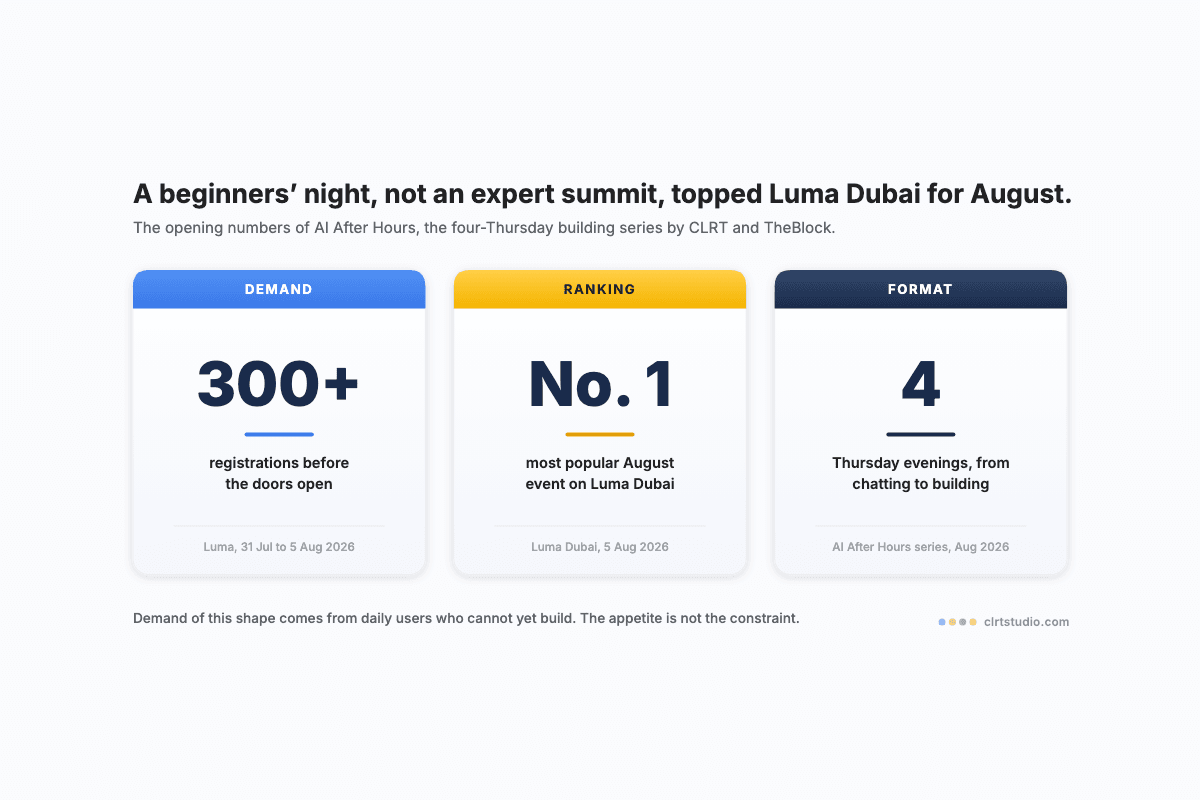
Two weeks into AI After Hours, the beginners' building series we are running with TheBlock in Dubai, we had two lists from the same people. The first came from the pre-session survey, sixteen answers to the question of what they wanted to learn. Twelve of the sixteen mentioned automation or agents. The word prompt appeared three times. The second list came from a one-line email sent after the second Thursday, asking each person for the single task they would love to never do again. All twenty-three people on the room list replied. Laid side by side, the lists do not describe the same problem. The first is a list of technology people have heard of. The second is a list of work they actually do, and it is the only one of the two that a business can build against.
Read the twenty-three replies as a set and a shape appears that nobody in the room asked to learn. Five were outreach in some form: cold calls, cold messages, prospecting and qualification, the follow-up email. Five were admin, timesheets, meetings, an inbox, accountancy, appointment reminders. Four were documents produced from scratch, client decks, presentations and spreadsheets, proposals, quotes. Three were content, the weekly post, a backlog that never fills, retail copy. Two were planning and data, a project plan with uncertain dates, a database. One was screening a hundred CVs, one was chasing deadlines across teams, one was automating the testing of a chatbot, and one reply was empty. When we sorted the twenty-three, they collapsed into five recurring patterns, and eighteen of them were answered directly by one of the five. The other five were the same five patterns wearing a different hat.
The mismatch between the two lists is not a failure of the room. It is how requests for technology always arrive. People ask for the thing they have heard named, and the name doing the most work this year is agent. As we put it on the twentieth of August, the word currently means a chatbot with a name, a workflow with ambition, and a genuinely autonomous system, three different things with three different price tags. The survey carried the same signal from another direction. Eight of the sixteen respondents use three AI assistants, one uses four, and the average is 2.4 tools per person, yet eleven of the sixteen still describe themselves as daily chat users and only three as people who build. Seven said they had built something with AI already. Tool count is not capability. A person can run three assistants and still be at chat, and most of this room was.
Exactly one of the twenty-three asks was intrinsically an automation job, the request to automate test runs on a chatbot, and even that one came back from us reframed as an evaluation problem: write the rubric by hand first, and make the grader cite the line it graded against. The remaining twenty-two did not need an agent in any of the word's three meanings. They needed a delegation brief and a check. A brief says what the task is, what it may touch, what good looks like and what a wrong answer looks like. A check is the point at which a person confirms the output before it leaves. The sentence we taught the room to separate the two categories is worth keeping: an automation repeats a decision you already made, an agent makes the decision again, every time, inside rules you wrote. Almost nothing on the second list wanted a decision remade. It wanted a decision made once and then carried.
So we built five machines instead of teaching agents. The Pipeline Engine answered the five outreach asks. The Proposal and Quote Factory answered the four document asks. The Morning Desk answered four of the admin asks. The Content Engine answered the three content asks. The Project Pulse answered the two planning and status asks. All five ran on one fictional four-person Dubai consultancy, with data we invented badly on purpose, typos, numbers buried mid-sentence, one arithmetic mistake left in, a client who quietly stops replying, a pipeline file nineteen days stale, because a machine that only works on clean data is a demo. The outreach asks taught us something too. Every one framed lead generation as a volume problem, more prospects, more messages. The fictional pipeline showed the opposite shape: the value was not in the prospects nobody had contacted but in the ones who had gone quiet and nobody had noticed.
The scarce thing in that room was never the tooling. It was the translation from what people said they wanted to what they needed gone, and that translation is a judgment, not a feature. The evidence is in the survey's last question, where thirteen people finished the sentence I wish AI could just. Three of them asked for the machine to tell them when it is wrong, to be transparent, to raise an early warning. That is a verification wish, and it is the most sophisticated request on either list, because it comes from people who have delegated something, watched it come back plausible and wrong, and understood that the check is the product. An organisation that hears its staff ask for agents and buys agents has skipped that step. The request arrives in vocabulary. The need arrives in the diary. Someone has to read the diary.
The request arrives in vocabulary. The need arrives in the diary. Someone has to read the diary.
A deeper dive
The mechanism behind the mismatch is simple and stubborn. A person who uses AI every day has a vocabulary shaped by what the market advertises, and this year the market advertises agents, so the learning wish is phrased in agents. The same person's week is shaped by the tasks that recur, and those tasks are prosaic: the follow-up nobody sent, the quote assembled from last month's quote, the deck rebuilt from the previous deck. The two vocabularies never meet, because nobody asks the second question. Ask what people want to learn and you get the technology list. Ask what they would never do again and you get the work list. Delegation is the bridge between them, and delegation is a skill most people have never been taught in any setting. DDI's assessment of more than 70,000 manager candidates found only 19% demonstrating strong delegation, and that is delegation to other humans, where the person receiving the task can ask a clarifying question. Delegating to a model is harder, because the brief must carry everything the model does not know. The five machines we built are five delegation briefs with five checks attached. That they are not agents is not a limitation. It is the point.
The second-order trap is what happens when an organisation acts on the first list. It hears agents, funds agents, and measures success by whether agents are running, which measures activity rather than work removed. Microsoft's 2026 Work Trend Index, vendor research built on 20,000 workers and the company's own telemetry, found organisational factors explaining 67% of the AI impact people report against 32% for individual mindset and behaviour, which is a precise way of saying the value sits in how work is arranged around the model, not in how enthusiastic the person is about it. Anthropic's own telemetry shows the arrangement is already shifting: directive conversations, where the person hands over a task and takes the result, rose from 27% of Claude.ai usage in late 2024 to 39% by August 2025. Delegation is deepening on its own. What does not deepen on its own is the choice of which tasks to delegate, in which order, with what check. That choice is where the twenty-three asks become five machines rather than twenty-three pilots, and it cannot be bought as software, because it starts with reading the diary of your own people and refusing to take the first answer they give.
Work with CLRT
Reading the diary is the work CLRT does. We take the tasks a team actually wants gone, sort them into the handful of patterns they always turn out to be, and build each one as a delegation brief with a check attached, so the work leaves the person's week without leaving the organisation's control. If your people are asking for agents and you are not sure what they need, the CLRT Ascent diagnostic at ascent.clrtstudio.com is where we begin: it starts from the work, not the vocabulary, and tells you where to point AI first. Bring us the second list, and we will show you the five machines hiding inside it.

Vishal Sachar is the Co-Founder and CEO of CLRT, where he helps UAE businesses make sense of applied agentic AI and put it to work. He writes on agentic systems, AI governance, and the economics of automation. Reach him at vishal@clrtstudio.com or on LinkedIn.