The Model You Rent Can Be Recalled

Co-Founder & CEO of CLRT
Anthropic introduced Claude Fable 5 on 9 June. Three days later the US government applied export controls to it and its sibling Mythos 5, and because there was no reliable way to verify a user's nationality in real time, Anthropic suspended access for everyone, everywhere. The order lifted on 30 June and the model returned on 1 July. For nineteen days, the most capable model on the market simply did not exist as a service: not for competitors, not for customers, not for anyone. No contract was breached. Nothing went down. The model was recalled, lawfully, and there was no lever any customer could pull.
It is worth being precise about what happened, because the vendors involved behaved unremarkably and the significance is easy to misread as drama. Anthropic complied with a government order and said so plainly. In the same month, OpenAI previewed its newest models, GPT-5.6 Sol, Terra and Luna, to roughly twenty partners whose participation had been shared with and approved by the US government, ahead of any public release. Two companies, two different mechanisms, one pattern. Frontier access is now politically mediated: the most capable models arrive staged, licensed, and revocable, and the decision to grant or withdraw them sits with neither the vendor nor the customer.
Every operations leader already knows how to think about vendor risk. Outages have status pages, SLAs have credits, deprecations have notice periods and migration windows. None of that machinery touches what happened in June. An export-control order is not an outage: there is no estimated time to restoration, no penalty clause, no account manager who can escalate. From inside a business that had built daily workflow on that one model, the experience was a supplier vanishing overnight, with no date attached to its return, for reasons that had nothing to do with the business itself. The risk is political, and procurement language does not reach it.
Readers in this region will find the shape familiar, because the Gulf has run on conditional access for years. The UAE's advanced-chip supply operates under a licensed framework, up to 500,000 Nvidia chips annually through 2030, granted and revocable by the same export-control apparatus. What June did was collapse the distance. The conditionality that used to apply to hardware crossing borders now applies to a model behind an API, and when access cannot be verified by nationality, the recall is global. A firm in Dubai and a firm in Denver lost the same model on the same day.
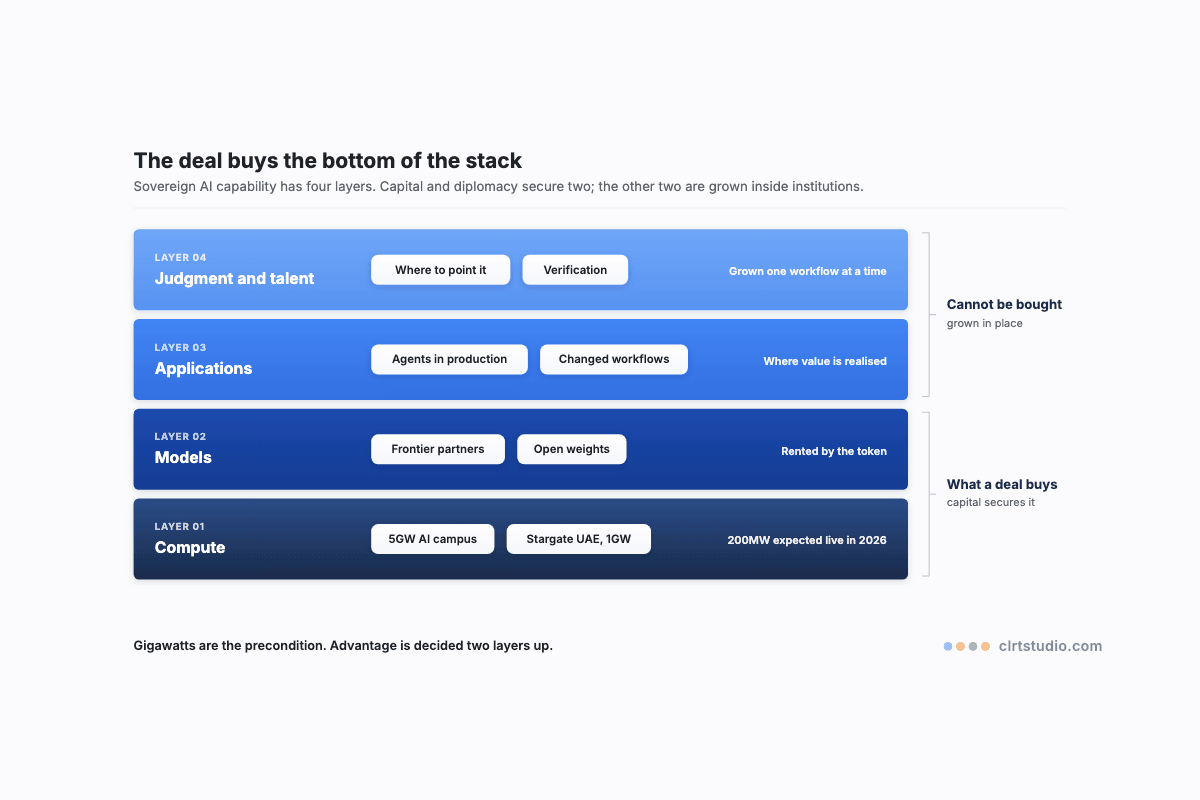
You cannot contract your way out of this, so the resolution has to be architectural. The durable value of an agentic system was never the model. It is the harness and tools that connect it to your operation, the evaluation suite that tells you whether any given engine is good enough for your tasks, the memory and context that hold what the system knows, and the policy layer that governs what it may touch. Those layers are built once and owned. The model is rented, and June demonstrated that rented things can be recalled. If your system treats the model as a replaceable part behind an interface, a recall is a routing change: you re-run your evals against the next engine and carry on with a measured, known loss of capability. If your system is welded to one vendor's model, the same recall is a stoppage, and its duration is decided in Washington rather than in your building.
An uptime SLA covers your vendor's failures. It does not cover your vendor's government.
A deeper dive
It is worth walking the stack, because the recall drew a line through it that most architecture diagrams never show. Policy and governance, the permissions, audit trail, and residency rules that decide what the system may touch: untouched by the recall. Evals and verification, the suite that defines what good enough means for your tasks: untouched, and quietly the most valuable asset in the building that month, because it is the thing that turns a forced migration into a measured one. Memory and context, the state, skills, and knowledge the system has accumulated: yours. The harness, the tools, the orchestration, the guardrails: yours. The model is the one band in the stack you do not own, and the teams that felt June worst were the ones whose value had quietly migrated into that band, prompt libraries tuned to one engine's quirks, workflows tested against one engine's behaviour, and no evaluation suite that could say what acceptable meant on any other. For them, switching was not a decision but an experiment run in production under pressure. The teams that barely noticed were the ones whose evals defined quality independently of any engine, so the question of whether the fallback was acceptable had a measurable answer within hours. The honest caveat is that no swap is free. Models have quirks, and a fallback that has never carried live traffic is a plan rather than a capability, which is why serious systems route a fraction of real work through the second engine routinely, in quiet months as well as loud ones.
There is little reason to treat June as a one-off. The same month produced a recall on one side of the market and a government-approved preview list on the other, which reads less like coincidence and more like the new shape of frontier distribution: capability and control negotiated between vendors and governments in real time, with every downstream business exposed to the outcome. I set out the architecture for this in Engine-Agnostic by Design; June supplied the proof that the risk it insures against is real rather than theoretical. The second-order effect worth watching is that model concentration will start to be priced the way key-person risk is priced. Boards already ask what happens if the one irreplaceable person leaves. The equivalent question, what happens to us if the model we depend on goes away for a month, is now a documented scenario with dates attached, and a continuity plan that cannot answer it is incomplete in a way an auditor can point to.
Key terms
- Engine-agnostic
- A system design in which the model sits behind an interface and the surrounding layers, the harness, evals, memory, and policy, do not depend on which engine answers. Swapping models becomes a routing decision measured by your own evaluation suite.
- Export control
- A government restriction on what may be supplied to whom. In June 2026 one was applied to a frontier model delivered as a service, suspending access worldwide rather than only at a border.
Work with CLRT
CLRT builds engine-agnostic by default. The harness, the evaluation suite, the memory, and the policy layer are built as yours; the model is a replaceable part behind an interface, chosen by rule and swapped on evidence. If reading the June timeline produced a specific uneasy feeling about a specific workflow, that feeling is your continuity plan telling you where it is incomplete. Bring us that workflow, and we will build the version that survives the next recall.

Vishal Sachar is the Co-Founder and CEO of CLRT, where he helps UAE businesses make sense of applied agentic AI and put it to work. He writes on agentic systems, AI governance, and the economics of automation. Reach him at vishal@clrtstudio.com or on LinkedIn.