The Right People in the Right Seats

Co-Founder & CEO of CLRT
The idea of a Zone of Genius, the work a person is both genuinely good at and energised by, scales. One person's map is a useful coaching tool. A whole organisation's map is a strategic instrument, because it answers a question every leader wrestles with and few can answer with evidence: who is in the wrong seat, and where the right answer is not another hire but an agent.
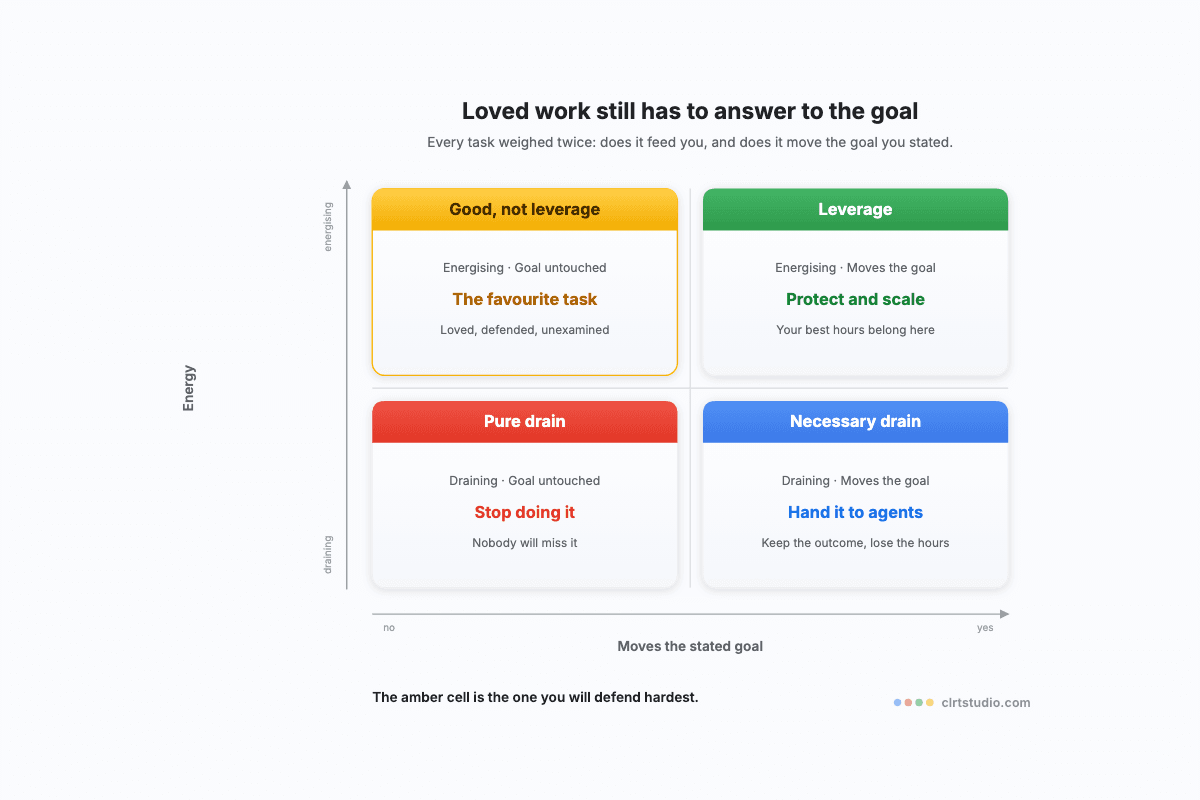
Plot every role's work on two axes, how skilled the person is at it and how much it energises them, and patterns surface that were invisible one person at a time. You find people stuck in high-skill, low-love seats, burning out while looking productive, the most expensive failure mode because it hides behind competence. You find people in low-skill, high-love seats, motivated but misplaced, who would thrive one seat over. And you find work that nobody is in their genius doing, which is the natural candidate for an agent.
The promise this unlocks is concrete. You get the best out of your people by moving them toward their genius, and you fill the gaps that remain with agents rather than headcount. "The right people in the right seats at the right times" stops being a motivational slogan and becomes something you can actually see and act on.
It also reframes the agent question correctly. Not "where can we remove people," but "what work is nobody's genius, that an agent should carry so the people can move up into theirs."
The goal is not a smaller team. It is every person in the seat that is theirs, and an agent in every seat that is no one's.
A deeper dive
Mapping at the organisation level beats optimising one person at a time because of a pattern that only appears in aggregate: one person's draining task is frequently another person's genius, which means a large share of the fix is internal reallocation before any automation. That matters, because moving work to the person who is energised by it is cheaper, faster, and better for morale than building anything. The agent candidates that remain are the tasks that are nobody's genius anywhere on the team, and that is a far better selection criterion than the usual "what is repetitive," because it targets work that is draining the organisation rather than merely frequent. The change-management consequence is the inversion at the heart of good AI adoption: people resist automation that threatens them and welcome automation that frees them, so leading with the genius map turns adoption from a push into a pull, which is the difference between a tool that gets used and one that gets quietly abandoned.
Work with CLRT
Seeing genius across a whole team, and knowing which gaps to fill with agents rather than hires, is a measurable exercise. CLRT runs it and designs the agent layer that follows. Start with a conversation.

Vishal Sachar is the Co-Founder and CEO of CLRT, where he helps UAE businesses make sense of applied agentic AI and put it to work. He writes on agentic systems, AI governance, and the economics of automation. Reach him at vishal@clrtstudio.com or on LinkedIn.