Ninety Percent Confident, Eighty-One Percent Blind

Co-Founder & CEO of CLRT
You report an agent count upward every quarter. It is a clean number, it grows, and the board likes it. Somewhere in your organisation there is a second number nobody reports: the agents a finance analyst, a sales manager or an operations lead built on a platform IT never approved, connected to data IT never mapped, and left running after the person who built them moved on. The first number is what you govern. The second is what you are accountable for. Late in September a vendor survey of chief information officers put both numbers side by side, in the same respondents, and the distance between them is the most useful thing a CIO or a COO can read this quarter, because it is not a story about careless people. It is a story about what a count can and cannot see.
Dataiku, which sells a platform for building and governing AI and should be read as vendor research, commissioned The Harris Poll to survey 685 CIOs across the United States, the United Kingdom, France, Germany, the UAE, Japan, South Korea and Singapore in July. Ninety percent said they are confident they have complete tracking of their agents. In the same survey, 81% said they lack complete oversight of agents created entirely outside approved systems or formal channels, and 83% said they lack standardised agent lifecycle management. Put the first two figures together and arithmetic does the rest: at least 71 of every 100 of these CIOs hold both views at once. That is not hypocrisy. It is a definition problem, and it is the more dangerous for being honest.
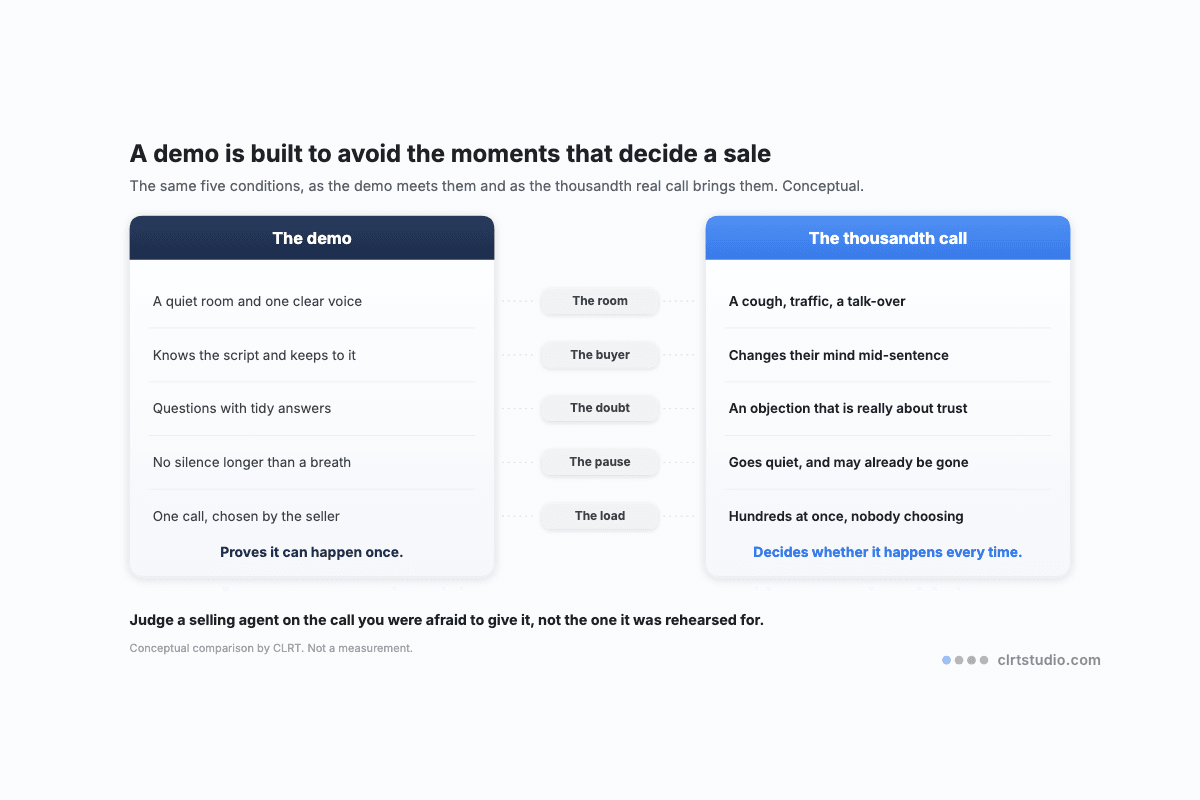
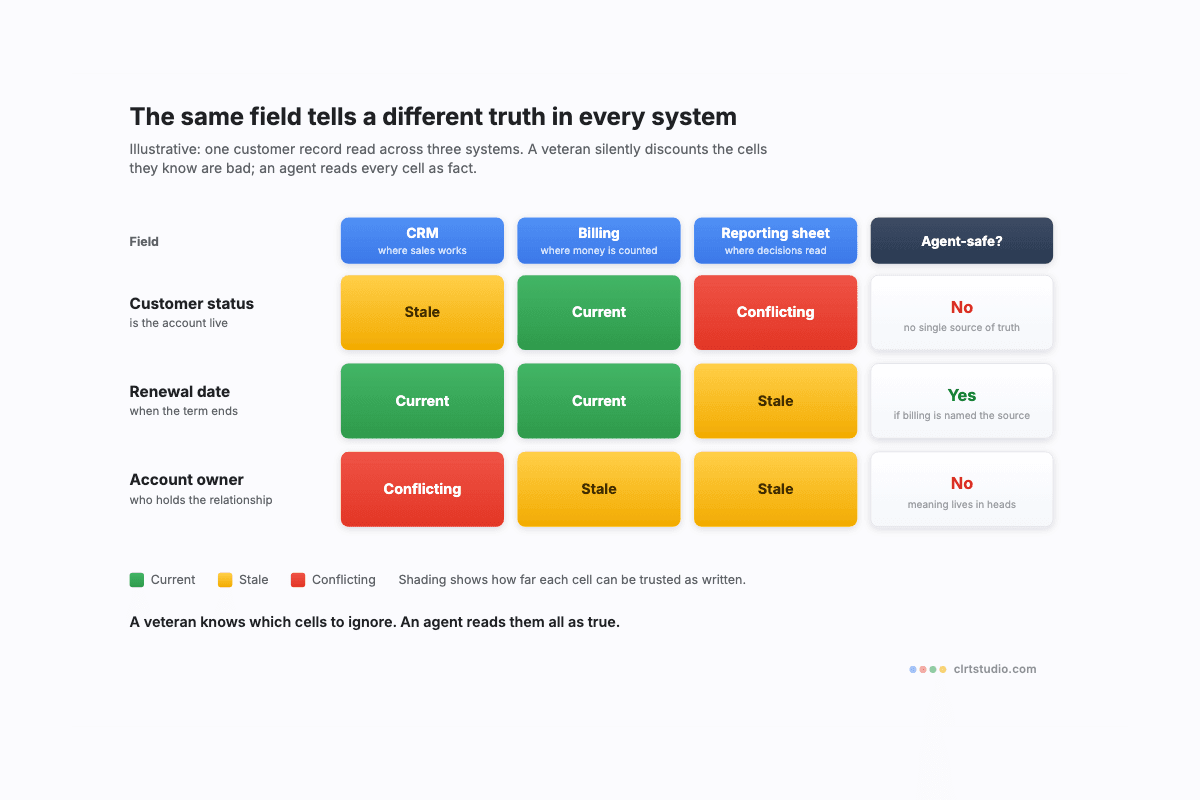
Complete tracking means complete relative to the register. A CIO who is confident is confident about the agents that came through the front door: requested, approved, provisioned and logged. The agents built inside a spreadsheet add-in, a no-code automation tool or a departmental workspace never reach the register, so they never threaten the confidence. The count is accurate and the estate is unknown, both at once. This is why the agent count is such a seductive number to report. It rises as adoption rises, it is easy to audit, and it measures exactly the population that was never the risk. The agents that create exposure are the ones that bypassed the process that produces the count. A bigger number on the board slide can mean better adoption, or it can mean that the estate underneath it grew faster still.
The scale makes the gap expensive. Two thirds of the CIOs in the survey estimate that 51 or more agents are running in production. Almost half, 47%, say they have already decommissioned more than 20 agents this year, which means the estate is not only large but turning over, with agents created, abandoned and replaced faster than any annual review can follow. And 84% agree that employees are creating agents and applications faster than IT can govern them. None of this describes a failure of policy. It describes a population that grows from the edges, where the people closest to the work see a task an agent could take and build it themselves, often well. The difficulty is that well built and governed are different properties, and only one of them is visible from the centre.
The same pattern shows up closer to home. ServiceNow's Enterprise AI Maturity Index, another vendor study, surveyed 100 UAE executives and found that 57% of their organisations have implemented agentic AI, while only 16% have AI testing, auditing and risk management processes in place. Adoption has run well ahead of the machinery that would let anyone vouch for it. Dataiku's figures add the last piece: 72% of CIOs cannot consistently measure whether all their agents are delivering business outcomes. So agents are counted where they are approved, unseen where they are not, and unmeasured in both places. An agent nobody measures is an agent nobody can retire with confidence, and an agent nobody can retire keeps its access, its data connections and its ability to act long after anyone remembers why it exists.
The instinct is to answer with a crackdown, a central catalogue every agent must enter before it may run. It rarely holds, because the agents worth having are often built by people who understood the task better than IT did, and a heavy gate pushes them further out of sight. Dataiku's own respondents seem to know it: 91% agree that the most effective AI strategy is not to centralise every application and agent but to let business teams build within a governed environment. The harder and more valuable question is which agents matter enough to sit inside the line at all. That is a judgement about the work, not the tooling: which tasks touch money, customers, regulated data or irreversible actions, and therefore which agents must be visible, owned and measured, and which can safely live at the edge. The count does not answer it. A map of the work does.
The agent count measures the agents that came through the front door. The exposure lives in the ones that never knocked.
A deeper dive
Shadow agents are not shadow IT with a new name, and treating them that way is the first trap. An unsanctioned spreadsheet or file-sharing account stores information. An agent acts on it. It holds credentials, it reads from systems of record, it sends, books, updates and approves, and it does so on a schedule nobody watches. When an employee builds one, the permissions it runs under are usually the builder's own, so it inherits whatever that person can reach and keeps it when that person changes role. Decommissioning makes this worse, not better. When 47% of CIOs report retiring more than 20 agents so far this year, the honest question is what retirement meant in each case: the agent stopped being used, or its access was revoked, its connections closed and its outputs traced to wherever they now sit. The first is common. The second is rare, because it requires knowing the agent existed in the first place, and an agent that is merely unused still holds every door it was ever given.
The second-order trap is that the measure becomes the target. Once a board celebrates the agent count, every incentive points toward registering more agents and none toward finding the ones that were never registered, because each discovery makes reported governance look worse before it looks better. A CIO who goes looking for the hidden estate will, in the first quarter, report a lower share of governed agents than one who does not look, and that is the moment most organisations quietly stop looking. The organisations that get this right change what they report. They stop presenting a count and start presenting coverage: of the work that touches money, customers and regulated data, how much is done by agents someone owns, can measure and can switch off. That figure starts low and is uncomfortable to show. It is also the only one that tells a board whether its confidence is earned, and producing it depends on first knowing where in the business agents should and should not be operating at all.
Work with CLRT
An agent count tells a board how much has been approved. It does not tell anyone where agents are acting on money, customers or regulated data without an owner, which is the question that decides whether the confidence is earned. CLRT works with leadership teams to map the work first, decide which agents belong inside the line and which can live at the edge, and build the ones that matter so they can be measured and switched off. To see where your own leverage and exposure sit, start with CLRT Ascent at ascent.clrtstudio.com, or bring CLRT the number you report and we will show you what sits beneath it.

Vishal Sachar is the Co-Founder and CEO of CLRT in Dubai. He helps businesses put agentic AI to work, leads practical AI workshops for leadership teams and operators, and writes on agentic systems, AI governance and the economics of automation. Reach him at vishal@clrtstudio.com or on LinkedIn.