People Buy What They Can See

Co-Founder & CEO of CLRT
If you run sales for a developer, a dealership or a premium brand, you have probably sat through a dozen agent demonstrations this year. A chatbot that answers in full sentences. A voice agent that pauses in the right places and never sounds like a machine. The comparison everyone invites you to make is how human each one seems. It is the wrong comparison. Your buyer is not deciding whether the agent is pleasant. They are deciding whether to commit money to something they have not yet seen, and every channel you are being offered leaves that part of the work to them. The form makes them wait. The chat makes them read. The voice makes them imagine. None of them puts the product in front of the person who is about to pay for it.
Watch the best salesperson in any showroom and notice how little of the job is talk. They walk the buyer to the model, open the door, turn the brochure to the page that answers the question just asked. The words and the object arrive together, and the timing is the skill: the thing appears at the moment the doubt does. Online selling lost that pairing years ago. The enquiry form took both the object and the conversation away and left a promise that someone would be in touch. The last two years have given the conversation back, first as text and now as a voice that is hard to tell from a person. What they have not given back is the object. The market is polishing the half of the sale that was never the bottleneck.
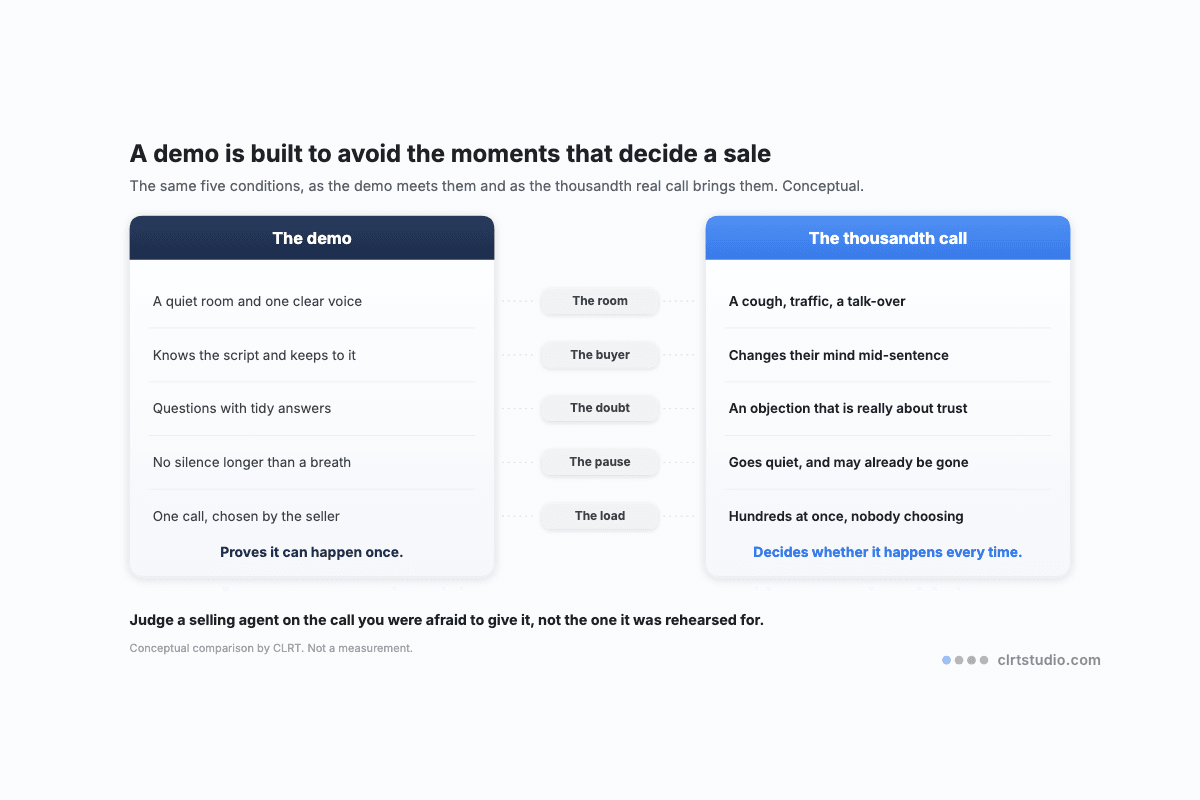
A voice agent that sounds entirely human is still describing. Ask it about a three-bedroom layout and it will tell you, fluently, where the kitchen sits and which way the balcony faces, and you will be holding a floor plan in your head while it moves on to the service charge. The work of picturing has been handed to the buyer, at the very moment they are also trying to listen. A chatbot moves the same work to reading: the buyer types, scrolls, opens a brochure in another tab and loses the thread between the two. Each of these channels splits attention between the conversation and the product, and the seam between them is where doubt grows. A warmer voice raises comfort. It does nothing for comprehension, and comprehension is what a buyer needs before committing money.
The clearest evidence that understanding outranks polish comes from language. CSA Research surveyed 8,709 online shoppers in 29 countries and found that 76% prefer to buy products with information in their own language, 40% will never buy from a website in another language, and 65% prefer content in their own language even when its quality is poor. The study is from 2020 and concerns web content, not conversation, so read it as a principle rather than a forecast. The principle is plain: buyers forgive rough, but not foreign. They buy what they understand on their own terms. A voice in the buyer's language removes one translation. A screen that shows the layout as it is being explained removes the other, the translation from words into a picture, which every buyer performs and no channel has been designed to remove.
Dubai's off-plan market is the sharpest test of the idea, because there the product does not yet exist. Dubai Land Department data for the first half of 2026, reported by Emirates 24/7, recorded 58,840 off-plan sales worth AED 139.75 billion, out of 86,000 property sales in all. Each of those buyers committed to something they could not walk through. They bought a plan, a render, a finish sample and a payment schedule, often from another country, often while comparing several projects at once. In that market, showing is not a feature of the sale. It is the sale. The developer whose agent can put the right unit, the right view and the right numbers in front of a buyer during the first conversation sells on its own terms. The developer whose agent can only describe them is asking the buyer to do the hardest part alone.
The hard part is not drawing a screen. It is making the screen follow the conversation rather than run beside it. The buyer interrupts to ask about the other layout, and the picture has to change while the voice carries on. They ask what the rental yield would be at a different price, and the figure has to be recalculated as it is spoken. The wrong image at the wrong sentence is worse than none, because it tells the buyer the seller is not listening. This is the problem CLRT built Closer, the Immersive Sales Agent, to solve: it speaks with the buyer and synchronises their screen in real time, so the finish, the layout and the numbers change as the conversation moves. The judgement underneath is what to show, when, and what to leave off the screen, and that is a sales decision before it is a technical one.
A better voice makes the agent more pleasant. A screen that follows the conversation makes the product real.
A deeper dive
The mechanism is reference. In a showroom, words like this one, the larger one and the view from there point at something both people can see, so every question is precise and every answer lands on the thing it was about. Remove the shared object and each of those words has to be rebuilt in the buyer's head from description, which means every question is also a test of memory. Misunderstanding does not announce itself. It surfaces later as a vague unease, a request to think about it, or a silence after the call. Put the product on the screen and the conversation changes character: questions narrow, objections become specific, and a specific objection can be answered. That is why seeing shortens a sale rather than merely decorating it. It converts the buyer's private picture, which the seller can neither inspect nor correct, into a shared one that both sides can point at, change and agree on.
The second-order trap is to treat showing as a gallery. Bolt a set of images onto a voice agent and the buyer will be looking at the third picture while the agent talks about the fifth, and the split attention returns in a new form. Fill the screen with every option and a decision turns into browsing, which feels like engagement and closes nothing. What the screen shows is also a statement the business stands behind: a price, a yield or a handover date shown to a buyer is as much the company's promise as anything said aloud, and far more likely to be captured and kept. So the real design question is editorial. Which single thing should the buyer see at this sentence, which numbers may appear and with what caveats, and what should never be shown without a person present. Those choices belong to people who know how the product is sold and what the business can stand behind, which is why the firms that win this will not be the ones with the most realistic voice.
Work with CLRT
CLRT built Closer for the moment a buyer needs to see what they are being told. Closer is the Immersive Sales Agent: it talks with your buyer and puts the product on their screen as it speaks, then qualifies them, books the viewing and moves the deal forward within the same conversation. The quickest way to judge whether it fits your sales is to be the buyer yourself. Talk to Tom at clrtstudio.com/closer, ask to see something, then ask for a different layout while he is speaking. Then talk to CLRT about what your own buyers should be shown, and when.

Vishal Sachar is the Co-Founder and CEO of CLRT in Dubai. He helps businesses put agentic AI to work, leads practical AI workshops for leadership teams and operators, and writes on agentic systems, AI governance and the economics of automation. Reach him at vishal@clrtstudio.com or on LinkedIn.