The Demo Is One Good Call

Co-Founder & CEO of CLRT
You have seen the demo, and it was good. The agent answered at once, sounded warm, understood the question and booked the appointment while the room nodded. It is a reasonable thing to be impressed by, and a dangerous thing to buy on. A demo is one call, chosen by the seller, in a quiet room, with a buyer who knows the script because the seller wrote it. Your business will not run on that call. It will run on the thousandth one, placed at an awkward hour by someone driving, half listening, interrupting, changing their mind halfway through and then going silent while they think. The question worth asking before you sign is not whether the agent can have a good conversation. It is what the agent does in all the conversations that are not good.
The talking has genuinely improved, and quickly. When OpenAI put its newest voice model into its API in September, its own launch figures showed turn-taking latency falling from 1.4 seconds to 0.8, and full-duplex interactivity, the measure of speaking and listening at the same time, rising from 45.4% to 80.1% against the previous model. Those are the qualities a demo shows off: the pause before the answer disappears, the agent stops when you speak over it, the rhythm starts to feel human. The same launch reported a third number that rarely makes the demo reel. On a banking voice support benchmark, the newest model passed 32% of tasks, up from 12.4%. These are the vendor's own figures, chosen by the vendor, and they say something precise. The conversation has become convincing well before the work inside it has become dependable.
A demo answers one question: can this happen once. Selling needs the answer to a different one: will it happen every time. Researchers at Sierra, a company that builds customer service agents, made that distinction measurable in 2024 with tau-bench, a vendor benchmark that puts an agent in conversation with a simulated customer and a set of company rules. The best agent they tested, built on gpt-4o, succeeded on 61.2% of retail tasks on a single attempt. Asked to solve the same task eight times, the chance it succeeded on every attempt fell below 25%. That gap is the distance between a demo and a deployment. The demo is the single attempt, rehearsed until it passes. The deployment is the eighth attempt, and the eight-hundredth, with no one choosing which calls get recorded. The models have moved on since, but the shape of that curve is the point, and no launch video is designed to show it.
Consider what actually happens on the thousandth call. The buyer coughs, and the agent hears a word that was never said. They start a sentence, stop, and start a different one, and the agent has already begun answering the first. They ask about the three-bedroom, then decide they want to hear about the two, then return to the three with a new condition attached. They raise an objection that is really a question about trust, phrased as a question about price. Then they go quiet for long enough that it might mean they are thinking, or reading a message, or gone. Each of these moments is ordinary, and each is a fork where the agent either keeps the conversation or loses it without anyone noticing. A demo avoids every one of them, not out of dishonesty but because a demo exists to show the path working, and these are the moments where the path breaks.
This is why the usual evaluation of a voice agent measures the wrong thing. A buyer watches the seller's best call, perhaps tries one of their own, and judges the voice: does it sound natural, is it quick, would a customer mind. Those qualities are fast becoming universal, because the market now sells them as a utility. What separates one agent from another is what nobody demonstrates. How does it recover when it is interrupted mid-sentence? Does it notice a change of mind, or carry on with the old plan? Does it answer the doubt beneath an objection, or recite the brochure? Does it hold its quality when hundreds of conversations are happening at once rather than one? These are not features you can see in a recording. They are properties you discover by trying to break the thing, and most buyers never try, because the demo was pleasant and breaking it feels rude.
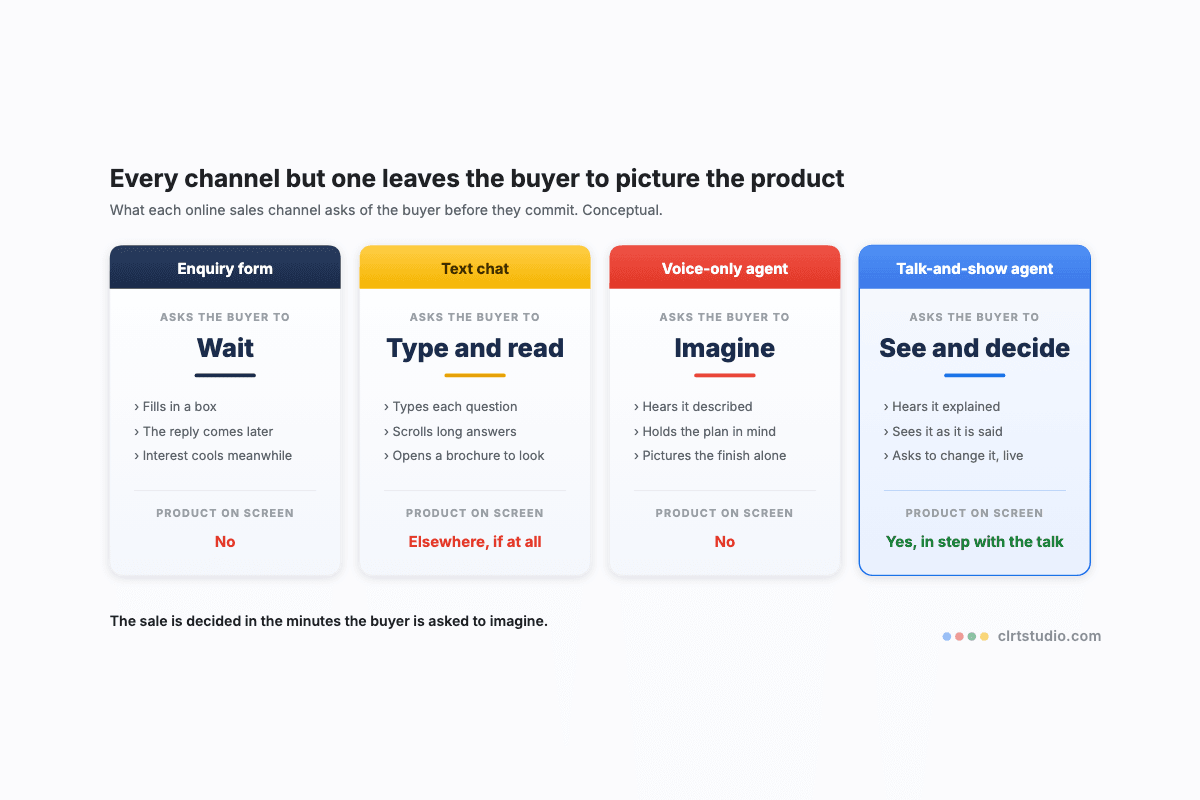
We built Closer, CLRT's immersive AI agent that speaks, shows and sells, with the thousandth call as the brief rather than the first. That choice changes what gets designed. The interruption is treated as the normal case, not an error to recover from. The objection is treated as the moment the sale is decided, not a detour from the script. And because a buyer who can see the home, the car or the treatment while it is being described has less reason to drift, the conversation shows as well as talks. None of this is visible in a polished minute of video, which is the honest point of this article. The only fair way to judge a selling agent is to give it a bad call and watch what happens next.
A demo proves the call can go well once. Selling depends on what happens in every call that does not.
A deeper dive
The mechanism behind the gap is compounding. A sales conversation is not one task, it is a chain of turns, and each turn is a fresh chance for the agent to mishear, misjudge or lose the thread. An agent that handles any single turn well most of the time will still, across a long call, very likely meet a turn it handles badly, and in a sales call one bad turn is often enough. That is why tau-bench's single-attempt score flattered its agents so much more than the eight-attempt one: reliability that looks comfortable on one try decays quickly when it must hold across many. Notice, too, who the customer was in that benchmark. It was a language model playing a customer, patient, cooperative and never distracted. Against that patient customer, the same agent managed 35.2% of tasks in the benchmark's airline domain on a single attempt. A real buyer on a real phone is harder than any simulated one, which means published scores of this kind are closer to a ceiling than a floor.
The second-order trap is quieter, and it is the one that costs money. When an agent fails a customer in a service queue, someone usually complains. When a selling agent fails a buyer, nobody does. The buyer simply stops engaging, says they will think about it, and never returns. No error is logged, the transcript reads as a normal call that ended early, and the dashboard counts it as a conversation handled. The business sees conversion drift down and concludes the leads have weakened or the market has cooled, while the real cause sits in moments nobody listened to. Teams that bought on the demo then compound the problem by tuning the agent toward the calls that already work, because those are the calls that get reviewed. The way out is to treat the lost moment, not the finished call, as the unit of judgment, and that means deciding in advance what a lost moment sounds like in your market.
Work with CLRT
CLRT built Closer for the calls that do not go to plan. Its launch film is out today at itscloser.com, where Closer sells a home, a hypercar, a company setup, an anniversary weekend and a clinic treatment, each one a conversation that turns. Watch it, then request a demo there and run it the way this article suggests: interrupt it, change your mind, raise the objection you actually hear, and go quiet. A selling agent should be judged on the call you were afraid to give it, and CLRT built Closer to be judged exactly that way.

Vishal Sachar is the Co-Founder and CEO of CLRT in Dubai. He helps businesses put agentic AI to work, leads practical AI workshops for leadership teams and operators, and writes on agentic systems, AI governance and the economics of automation. Reach him at vishal@clrtstudio.com or on LinkedIn.