The Expensive Middle of the Agent Road

Co-Founder & CEO of CLRT
Ask most leadership teams how their AI programme is governed and the answer comes back with quiet pride: the agents do the work, a person approves it, nothing happens without a human signature. It sounds like the sensible path between recklessness and standing still. On 13 October, Wharton's Human-AI Research group and the research firm GBK Collective published their fourth annual study of US enterprises with at least 1,000 employees, roughly 1,400 respondents, and it puts that posture somewhere uncomfortable. Departments where AI only advises reach transformational success 25 percent of the time. Departments using agentic AI to its fullest reach it 31 percent of the time. Departments where a person approves every action reach it 16 percent of the time, the lowest figure anywhere on the road. The responsible middle is the expensive one.
The report's own sentence is blunter than most consultants would dare: organisations "are highly rewarded for reaching the end of the agentic implementation roadmap but suffer while they are in the middle", and return, it adds, follows the same shape. Read the numbers as a curve and they draw a valley, not a ramp. The model in most boardrooms is a staircase, where each increment of autonomy buys an increment of value, so a company that has moved from advice to supervised action should be partway up. The data shows a dip instead. Departments that let AI act under approval report a lower success rate than those where it only advises, and checking a sample after the fact, at 18 percent, barely climbs out. The caution matters. This is self-reported survey data, the fully agentic group is a small sample the report asks readers to treat as directional, the authors describe association rather than causation, and the far end of the road may simply hold better-run companies. But the valley fits a mechanism every operator recognises the moment it is named.
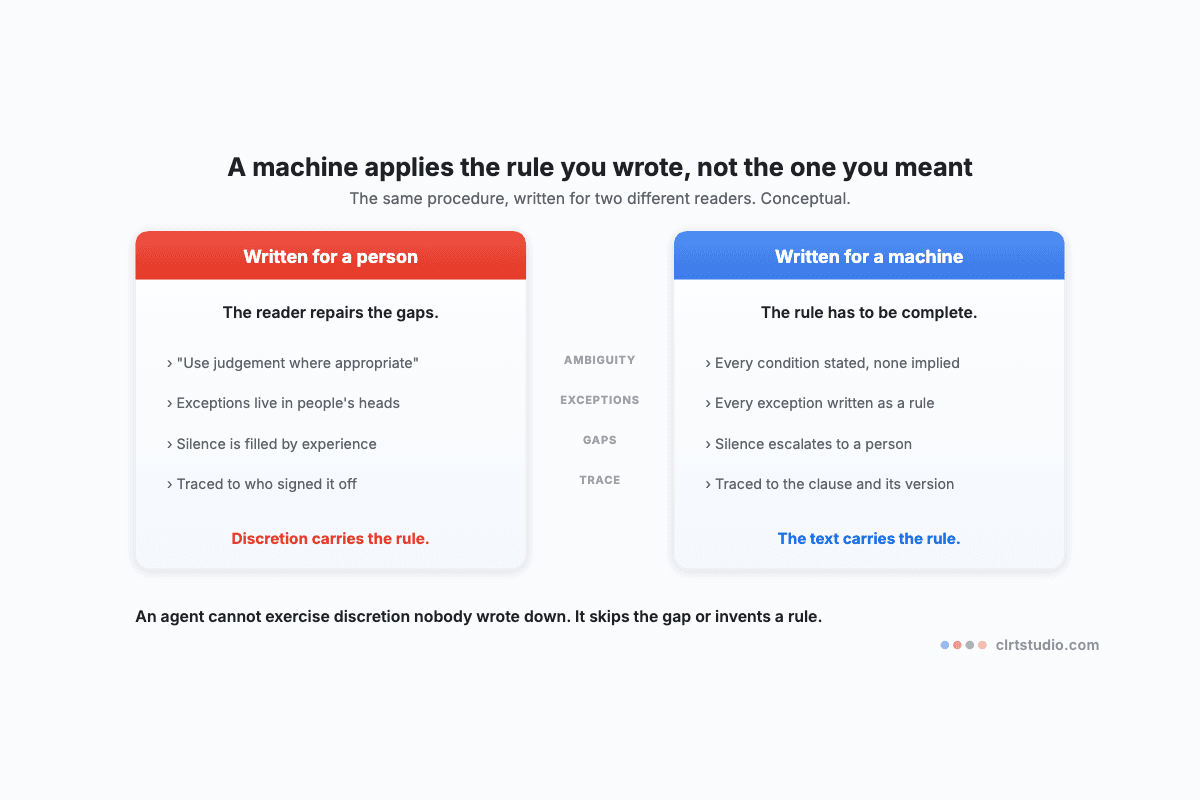
An agent whose every action waits for a person has not removed any work. It has rearranged it. The human who used to do the task now reads, checks and signs the agent's version of it, often at much the same pace as doing it, and with less context, because they did not build the reasoning they are approving. The company pays the licences, the compute and the integration for the agent, and the salary and attention for the approver, and it receives the throughput of whichever is slower, which is the person. Advice-only departments avoid this because they never pretended the work had moved. Fully agentic ones avoid it because the work actually moved. The middle carries both cost lines and neither benefit, and it carries them indefinitely, because approval is rarely a phase with an end date. The report expects the price of this "supervised middle" to become more evident as costs rise.
This would be a curiosity if few companies stood there. Nearly half do, the single largest group, and the 10 percent who sample afterwards fare little better, at 18 percent. In 35 percent of departments, AI suggests or drafts and a person makes every final call. In the largest group, 48 percent, AI performs the work and a person reviews and approves it before anything happens. Only 17 percent permit what the report calls genuine autonomy: 10 percent review a sample of the output afterwards, and 7 percent rely on real-time monitoring and systematic guardrails instead of human review. Put plainly, the single most common posture in large American enterprises is the one at the bottom of the valley. Two thirds of departments, 67 percent, say they use agents in some form, and that is the number that reaches the board pack. The number that describes the business, how many let an agent finish a piece of work without a signature, is 17. Adoption has been counted. Depth has not.
The second finding explains why the middle is so hard to leave: the top of the company does not believe it is there. Among departments that let AI act at all, 42 percent of C-suite respondents say theirs lets it take irreversible actions. Among managers and directors, the people who run the work, the figure is 24 percent. The executives are either describing a different company or describing the one they assume they have. Accountability is less settled still. When an agent errs, a governance or risk team is named by 28 percent, the deploying employee's manager by 26, the employee by 25 and the vendor by 9, while 11 percent say nobody is clearly accountable or do not know. No owner reaches 30 percent. And the uncertainty sits exactly where the approving happens: 20 percent of managers and directors say nobody is accountable or cannot say, against 3 percent of those at VP level and above.
The reflex is to add more review, and the data closes that door too. Fewer than 1 percent of departments report no formal process for checking agent performance. Oversight is already everywhere. What separates the transformed departments is its kind. Those that monitor agents automatically have transformed their workflows at 24 percent against 9 percent, while relying on people to review the output makes roughly no difference. Where agents may take irreversible financial or legal actions, 29 percent have transformed, against 13 percent where they may not, and the report reads this as depth rather than reach: authority was granted where AI had already been built into the core of the work. The way out of the valley is neither courage nor caution. It is deciding, process by process, which actions a system can verify better than a signature, and building the evidence that lets the signature go.
The middle carries both cost lines and neither benefit, and it carries them indefinitely, because approval is rarely a phase with an end date.
A deeper dive
The second-order trap is what the signature quietly becomes. In the middle, approval stops being a check and turns into the place where accountability is parked. The approver is not really verifying the agent's work, because they rarely have the evidence to do so, the inputs it read, the rule it applied, the alternative it rejected. They are signing so that a named person owns the outcome. That is why the accountability answers scatter across the manager and the employee: the organisation has not decided who answers for an agent, so it has made whoever touched the approval answer by default. Now add the perception gap. If the executive team believes agents already take irreversible actions, the business case it approved was written for the far end of the road, with its returns, while the operation is paying the costs of the middle. Nobody is lying. The board is measuring adoption, the floor is running approvals, and the gap between them is where the missing return lives.
What makes this hard is that leaving the middle is not one decision and not one direction. Some processes should move forward, to automated checks and real-time monitoring, because their outputs can be verified by a system more reliably than by a tired reader. Others should move backwards, honestly, to advice only, because their actions are irreversible and their quality cannot yet be evidenced, and on this data advice outperforms supervised action anyway. Deciding which is which means reading each process for reversibility, verifiability and cost of error, then building the instrumentation that turns trust from a feeling into a record. Asked what holds back AI that acts on its own, respondents at manager level and above name trust and risk: data security at 43 percent and distrust of the AI's reasoning at 23, while a shortage of skills ranks last at 8. That ranking is telling. Trust is not a mood a leadership team can declare. It is an output of design, and no vendor's autonomy slider, however finely graded, produces it.
Work with CLRT
Getting out of the middle is not a setting. It is a judgment made process by process: which actions a system can verify, which should go back to advice, which can earn real authority, and who answers for each. That is the work CLRT does, together with the monitoring and evidence that let a signature be retired rather than rubber-stamped. If you want to know where your own agents sit on this road, and which way each should move, CLRT Ascent at ascent.clrtstudio.com is built to answer exactly that. Bring us the process everyone approves and nobody trusts.

Vishal Sachar is the Co-Founder and CEO of CLRT in Dubai. He helps businesses put agentic AI to work, leads practical AI workshops for leadership teams and operators, and writes on agentic systems, AI governance and the economics of automation. Reach him at vishal@clrtstudio.com or on LinkedIn.