Your Agent's Promise Is Your Promise

Co-Founder & CEO of CLRT
You are about to let an AI agent talk to your buyers, and the guardrail plan fits on one line: it will not hallucinate. The vendor has shown you the grounding, the retrieval, the refusal to invent a product you do not sell. All of that matters, and none of it answers the question that will actually reach your desk. The agent will not be in trouble for saying something false about the world. It will be in trouble for saying something true about your business that nobody authorised it to say: that the price holds until Friday, that the viewing is booked, that the deposit is refundable. A buyer does not hear those as outputs. They hear them as commitments, made by you, and increasingly the law hears them the same way.
The hallucination frame treats a selling agent as a source of information and asks whether the information is accurate. That is the right question for a search box and the wrong one for anything that sells. A sales conversation is a sequence of small commitments, and the agent's job is to make them. The case everyone cites makes the point precisely. In Moffatt v Air Canada, a British Columbia tribunal heard the airline argue, in effect, that its website chatbot was a separate legal entity responsible for its own actions. The tribunal rejected that, observing that a chatbot is still just part of the company's website and that the company is responsible for all the information on it. The chatbot had not invented a flight. It had described a refund policy the airline did not offer, plausibly and politely, and the customer reasonably relied on it. That is not a hallucination problem. It is an authority problem.
What began as a small-claims anecdote in 2024 is becoming written law. California's Civil Code section 1714.46, in the code from January 2026, says that a defendant who developed, modified or used artificial intelligence may not argue that the AI autonomously caused the harm; causation and comparative fault remain arguable, the machine as scapegoat does not. In the UAE, the Central Bank's telemarketing rules for licensed financial institutions, published in March, let customers choose between a human, a robocall and an AI agent, and require a log of telemarketing activity kept for at least five years. In the European Union, Article 50 of the AI Act has applied since 2 August, requiring that people are told when they are dealing with an AI system, with fines of up to EUR 15 million or 3 percent of worldwide turnover under Article 99. Different duties, one direction: what the agent says is on your record.
So the useful question is not whether the agent is accurate. It is which promises the agent may make at all, and every selling conversation sits somewhere on a spectrum of them. At one end the agent informs: it describes a product, a location, a process. Then it recommends, which implies a judgement about fit. Then it quotes, which states a number the buyer will remember. Then it holds a price, which is an offer with an expiry. Then it books, which commits a person's time. At the far end it takes a deposit, which moves money and creates a contract. Each step to the right turns a sentence into an obligation, and each needs a different kind of governance: a source of truth on the left, a fit rule, a live price with stated validity, a floor and an owner, a calendar the team will honour, and finally payment terms, refunds and a human sign-off threshold.
Reliability then means something stricter than accuracy. A promise is a commitment to say the same thing every time, and agents are measurably worse at that than at being right once. Sierra's tau-bench, a vendor benchmark published in June 2024, found that even state-of-the-art function-calling agents succeeded on fewer than half of its tasks, and introduced a measure of whether an agent succeeds on all of several attempts at the same task. In its retail domain, where the best agent solved about six tasks in ten on one attempt, success on all of eight attempts fell below 25 percent. The paper is from 2024 and the models have moved on, but the gap it measures is structural: performance on one attempt flatters performance on many. For a selling agent, the eighth buyer to ask about the cancellation terms is owed the same answer as the first. If they get a kinder one, the business has made a promise it never decided to make.
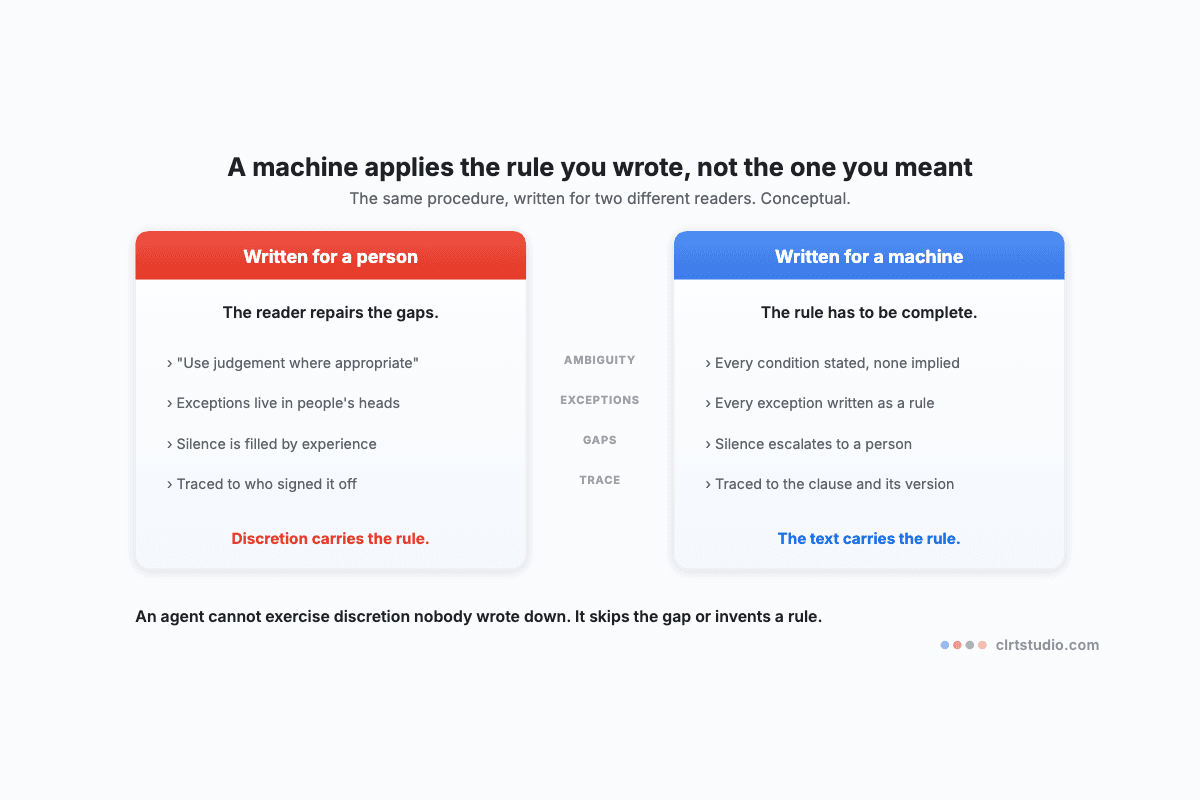
This is the premise CLRT built Closer on. Closer talks with buyers and shows them what it is describing, and it can carry a conversation through to the booking and the payment, which places it at the far right of the spectrum by design. That is exactly why its limits are decided before its first call rather than discovered after its hundredth: which prices it may state and for how long, which concessions it may never offer, which bookings it may confirm and against whose calendar, when a payment needs a person. The agent that can do the most is the one that most needs a written mandate. Governance of a selling agent is not a filter on its words. It is the delegation of authority, made deliberately, by the people who will answer for it.
A selling agent's risk is not a false fact about the world. It is a promise about your business the buyer is entitled to believe.
A deeper dive
The mechanism that catches most companies is that authority arrives through connection, not instruction. An agent told in its prompt never to discount, but wired to the booking system and a payment link, has the power to commit whatever its words imply, and the instruction is only as strong as the model's adherence on the worst call of the month. The limit has to live in the system that executes, where the price floor, the expiry and the refund rule are facts the agent reads rather than suggestions it weighs. Every integration a team adds for convenience is a quiet promotion along the spectrum, and because each one is individually sensible, nobody ever looks at the total authority the agent now holds. The record compounds it. A promise made on a call outlives the call: the buyer remembers it, may have captured it, and in regulated sectors the log of it must now be kept for years. The agent's worst sentence is no longer ephemeral. It is evidence.
The second-order trap is that quality raises the stakes. The more fluent, patient and human the agent becomes, the more reasonable it is for a buyer to rely on what it says, and reasonable reliance is precisely the test the airline failed. A clumsy bot that nobody trusts makes few binding promises; a persuasive one makes them all day. The same applies to the safety valve. Teams write escalation in as the cure, and then the escalation sentence itself becomes a promise: telling a buyer that someone will confirm the discount tomorrow implies the discount exists. Designing this well means reading the business the way a sales director reads a new hire's first month, deciding what they may say alone, what they may say with a manager's name attached, and what they must never say at all, and then encoding those decisions as hard limits, consistent answers and an audit trail that shows exactly what was promised. That is not a model feature. It is judgement about the business, made in advance.
Work with CLRT
Deciding what a selling agent may promise is the work CLRT does before an agent ever speaks to a buyer. We built Closer, CLRT's immersive sales agent, which speaks with a buyer while their screen follows what it says, so that each business's limits are written in before the first call: what it may quote, what it may hold, what it may book and when a person must sign. If you are about to let an agent sell for you, talk to Tom at clrtstudio.com/closer, then bring us the promises your team makes today and we will help you decide which ones your agent should make.

Vishal Sachar is the Co-Founder and CEO of CLRT in Dubai. He helps businesses put agentic AI to work, leads practical AI workshops for leadership teams and operators, and writes on agentic systems, AI governance and the economics of automation. Reach him at vishal@clrtstudio.com or on LinkedIn.