The Rulebook Is the Bottleneck

Co-Founder & CEO of CLRT
On 2 November, Abu Dhabi signed four agreements with OpenAI. It is easy to read them the way deals are usually read: a government buying the frontier. Look at what the government side actually committed to and the purchase turns out to be the easy part. The Department of Government Enablement calls it machine-readable government. It translates a defined set of policies and regulations into a form an AI system can apply, so the system can help officials with compliance checks for permits and certificates, each assessment traceable to the rule that governs it and the final decision left with an official. That is not a technology project. It is a rewrite of the rulebook, and if your procedures live in PDFs and in the heads of a few long-serving people, it is the project you have not budgeted for.
The revealing detail sits in the first pilot. Food imports at the Abu Dhabi Agriculture and Food Safety Authority went first, and The National reports that thousands of policy documents governing them have been made accessible to AI. Faisal Al Hawi, who directs the department's AI Factory, told the paper that work began at the start of the year, and that complex cases which took a few days to a week can now be done in minutes. That is his claim, not a measured result, and it is the least interesting thing he said. The more telling line was about ownership: everything built as machine-readable government belongs to the department. In effect, the model is rented. The encoded rulebook is the asset, and ten months after work began, one domain of it is in production.
This is the hard part because every organisation's rules were written for a particular reader, a person, and people are extraordinary at repairing a document. A procedure says complex cases go to a senior reviewer and never defines complex, and the team simply knows. A policy says use judgement where appropriate, and the judgement is supplied by fifteen years of experience and a quick call down the corridor. Two policies contradict each other, and the experienced reader knows which one wins in practice. The written procedure is a summary of the real one, and the gap between them is filled with discretion nobody recorded. An agent reads only the summary. It cannot ring the corridor. Faced with a gap, it either skips it or fills it with a rule of its own invention, delivered in the same fluent register as everything else, which is the more dangerous of the two.
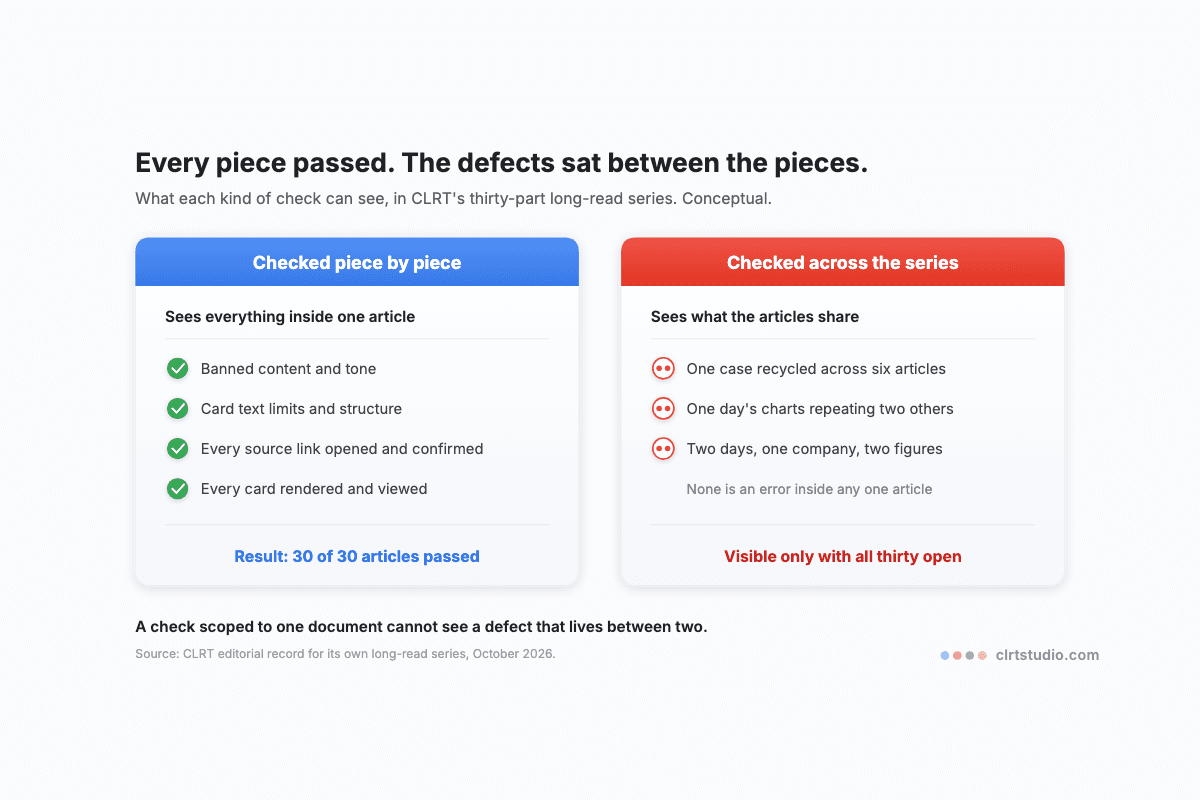
Abu Dhabi's design makes the standard explicit. Each assessment is meant to be traceable to the governing rule, and officials keep oversight and accountability for the final decision. Traceability sounds like a logging feature. It is actually a demand on the rulebook. To cite the clause behind a decision, the clause has to exist as a discrete, current, unambiguous thing, with a version in force on the day the decision was made. Ask that of a typical company's operating procedures and watch them come apart: three copies of the refund policy, an approval matrix last updated before the reorganisation, a threshold that changed in an email in March. A person can work around all of that. An agent working around it produces decisions nobody can defend, because the only honest account of why it decided something is that it guessed which document you meant.
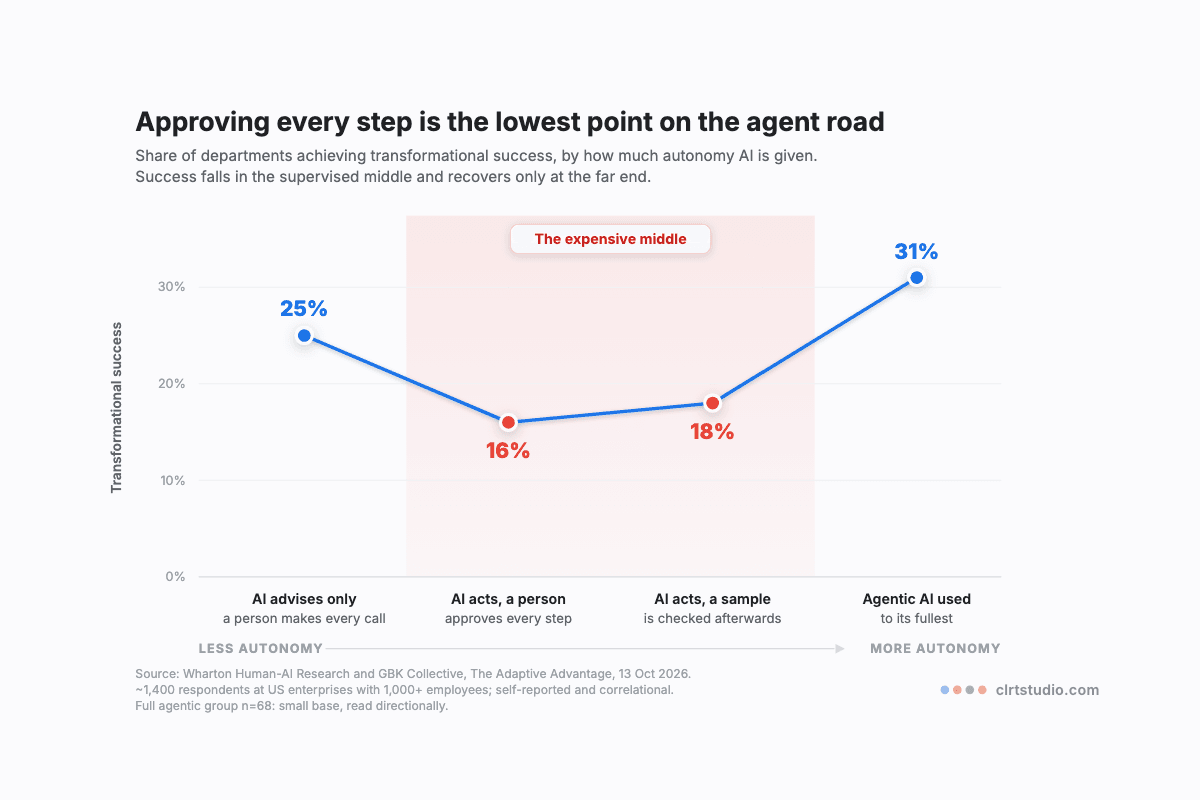
The private sector's own numbers suggest this step is being skipped. ServiceNow's Enterprise AI Maturity Index, vendor research built on a ThoughtLab survey that included 100 UAE executives, found that 57 percent of UAE organisations have implemented agentic AI, but only 7 percent have used it to build autonomous workflows, and only 16 percent have AI testing, auditing and risk management processes. The same release has 77 percent citing inadequate data accuracy, access and management as a major barrier. Read together, the distance between installing agents and letting them run the work does not look like a shortage of model capability. It looks like a shortage of rules an agent can be held to, and of any means of checking that it kept them. Data quality has a budget line and a name. Rule quality has neither, and it fails in the same way.
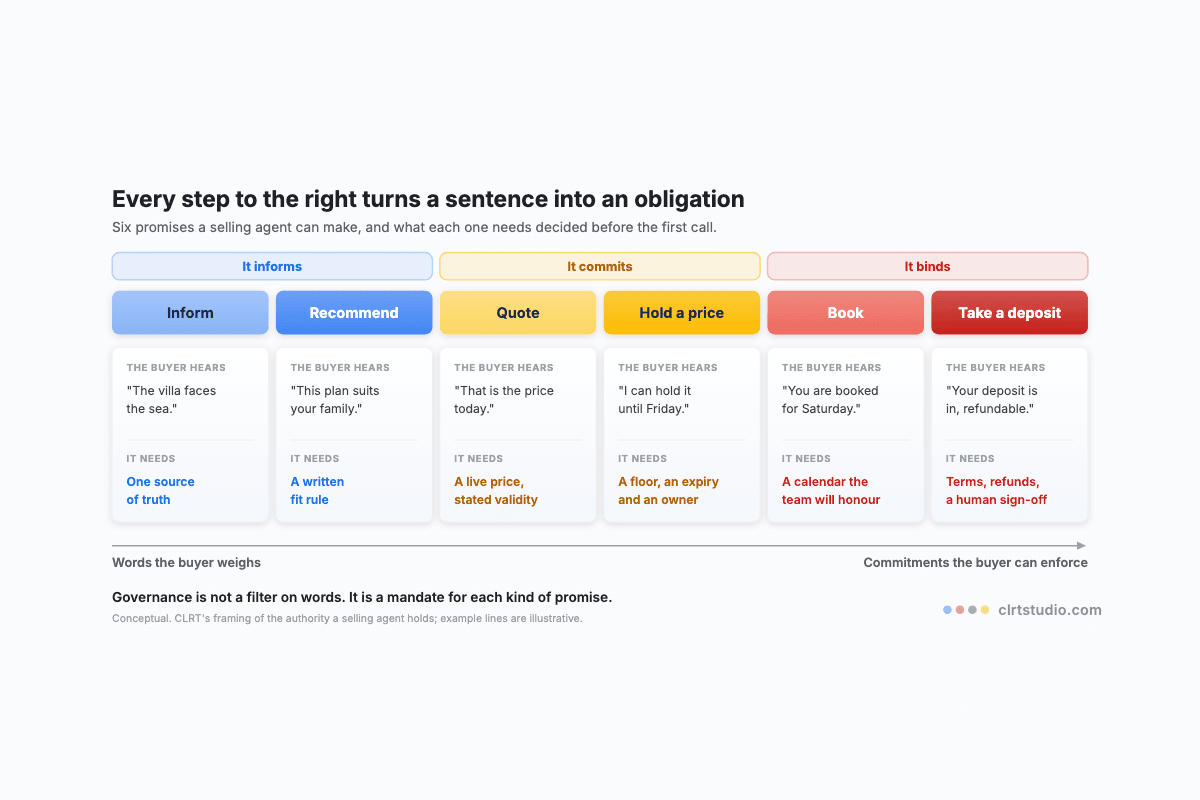
The government is not stopping at food imports. Building permits, business licences and inspections are the next services the department has named, and in Dubai a new accelerator will assess more than 300 public-facing use cases across 33 government entities. Companies will increasingly meet machine-applied rules on the far side of the counter, assessed quickly and traced to a clause, while their own side of the transaction stays slow and ambiguous. Closing that gap is not a matter of choosing a model. It means deciding which rules to encode first, which discretion is genuine judgement worth keeping with a person and which is only an undocumented habit, and who owns the rulebook once a machine is applying it. Those are operating decisions, and they are exactly where AI programmes quietly stall.
The model is rented. The rulebook, rewritten so a machine can apply it and trace every decision back to a clause, is the asset.
A deeper dive
Encoding a rulebook is uncomfortable for a reason that has little to do with technology. Ambiguity in a procedure is rarely an accident. It is often the residue of a disagreement nobody resolved: finance and sales never settled who may approve a discount above the line, so the policy says senior approval and leaves the word senior undefined. Writing the rule for a machine drags the argument back into the open, because the machine needs an answer and cannot be told that it depends. Every undefined word in a policy marks a decision someone avoided, and the rewrite presents the whole backlog at once. This is why the work stalls in-house. It looks like documentation, so it is handed to someone without the authority to settle the disputes it surfaces, and it returns months later as a cleaner copy of the same ambiguity. The organisations that get through it treat the rewrite as a governance exercise with an owner who can make calls, not as a knowledge-management project with a template.
The second-order traps are subtler. The first is encoding the rule as written, when the written rule stopped describing practice years ago; the agent then enforces, faithfully, a procedure nobody follows, and the business discovers the drift through complaints. The second is the opposite shortcut, letting a model infer the rules from past decisions, which turns every historic exception, favour and inconsistency into precedent, now applied at scale with a confident explanation attached. The third is time. Rules change, and a decision is only traceable if it points to the version in force on the day it was made, which means the rulebook needs owners, change control and retirement dates like any production system. Keeping the final decision with a person, as Abu Dhabi has, only helps if that person can see which clause the machine relied on. None of this appears in a model demonstration, where the rule is always clean, current and singular. It appears in the first audit, when someone asks which clause a decision rested on and the honest answer is three of them.
Work with CLRT
CLRT does the work that sits between a signed AI deal and a decision a machine can defend. We find which of your rules are ready to be applied by an agent, which hide disagreements that need an owner to settle, and which discretion should stay with a person, then we build the traceable path from clause to decision. If you want to know where in your operation a rewritten rulebook would pay first, the CLRT Ascent diagnostic at ascent.clrtstudio.com is built to reach that judgement. Bring us the procedure everyone works around, and we will show you what a machine would make of it.

Vishal Sachar is the Co-Founder and CEO of CLRT in Dubai. He helps businesses put agentic AI to work, leads practical AI workshops for leadership teams and operators, and writes on agentic systems, AI governance and the economics of automation. Reach him at vishal@clrtstudio.com or on LinkedIn.